Ray Kelly, the NYC Police Commissioner, seems to believe that "Stop and Frisk" has been responsible for the decrease in murders during Mayor Bloomberg's term. He says so himself in an op-ed in the Wall Street Journal. As usual, when someone starts throwing around statistics, I think it is a load of horse hockey.
To begin it rests on the premise that "In the 11 years before Mayor Michael Bloomberg took office, there were 13,212 murders in New York City. During the 11 years of his administration, there have been 5,849. That's 7,383 lives saved..." So lets start without even looking at any statistics.
The 11 years before Mayor Bloomberg took over (1991-2001), included the years 1991-1994 which is when the US saw some of the highest violent crime rates in all categories. NYC also had rates that were usually reserved for nearly lawless third world countries. But Guiliani cleaned that all up, right? At least that is what he took credit for.
Using the FBI Uniform Crime Report tool, I did a quick analysis of what happened in NYC and the US during two periods 1992-2001 and 2002-2011. Ten years each (because the FBI doesn't have the final 2012 numbers online yet). If "Stop and Frisk" has been effective, then not only should it show an improvement from the earlier years, but it should also show an improvement compared to the rest of the country which doesn't have "Stop and Frisk."
I compared three geographic areas: New York City, New York State minus New York City, and the United States minus New York City. Comparing the two 10 year periods, Bloomberg had only 49% of the murders as the previous. New York State had 92%. The US had 84%. So, initially it is looking like Bloomberg may be on to something with "Stop and Frisk."
But those are total numbers of murders, and as already mentioned it was comparing a time when we had the highest murder rates of the last century to a time when we had some of the lowest murder rates of the last century, not exactly a fair comparison. So lets compare rates instead. The population of New York City has grown by about 10% over the last 20 years. The State of NY (minus NYC) has grown about 5%. While the US has grown by more than 20%.
Between 1992 and 2001 the murder rate in NYC dropped by 67%. In New York State, it fell only 41%, and in the US it fell 37%. So, if Guiliani wants to tout his crime fighting prowess, he definitely has a leg to stand on (although I would dispute this as well).
How about Bloomberg. From the start of his reign, 2002 through 2011, the murder rate fell 14%, with "Stop and Frisk." In the rest of New York State, without "Stop and Frisk" the rate fell 21%, and the US it fell 17%. Both of those more than Bloomberg's fiefdom. But New York City is a big city, right?
Right, so I used the UCR tool to compare with other Metropolitan areas over 1,000,000. There are 10 in the US. Only two had a change in murder rate from 2002-2010 that was worse than New York City. Los Angeles cut their murder rate by 55% in that period. More impressive is San Diego which had a murder rate already half of New York's and they cut their's by more than 40%. So, seven out of nine large cities had larger decreases in the murder rate than New York City, without using "Stop and Frisk."
So, is "Stop and Frisk" effective? I don't know, but the murder statistics that Ray Kelly uses certainly don't show that they are. New York's decrease in murder rate has been rather anemic. Even if I look at the overall violent crime rate, two cities are less, three are the same, and three are more than New York. So New York appears to have had a typical decrease in crime for the time period.
So, the question that should be asked is, if "Stop and Frisk" doesn't show a significant decrease in violent crime and it has the potential to violate the rights of citizens, then why do it? There doesn't appear to be an upside (decreased crime) but there is all sorts of downsides (less trust of police, civil rights violations, etc.). Sounds like lousy policy to me, but that may be why I am not an elected official.
Showing posts with label Government. Show all posts
Showing posts with label Government. Show all posts
Wednesday, July 24, 2013

Friday, March 15, 2013
The Cost of Universal Background Checks
The Senate now has a bill that would require universal background checks in the hope that this will keep guns out of the hands of criminals. While we can all admit that it won't keep all of the guns out of their hands (afterall, Great Britain's criminals have had no problem getting their hands on guns), we should ask ourselves two questions before considering whether this is a viable solution 1) How much is this going to cost (and to whom)? 2) How many guns is this going to keep out of criminals hands (and thereby how many crimes are averted)?
OK, that is 4 questions. And I haven't even brought up the 2nd Amendment. Let me look at this issue universally so that it could be applied whether there was a 2nd Amendment or not and whether people had a natural right to self defense or not. In other words, if it passes the "economics" test we can consider it and debate other issues, if it doesn't then there is no need to debate this further - i.e. it is unicorn rainbow farts.
Obviously, I am prejudiced. We all are. The dispicable ones are those who don't admit it. I am prejudiced for facts. I am prejudiced for truth. So, before you say that I am opinionated and discount my opinion, back up your opinion with facts.
Lets start with question 1) How much is this going to cost? Well, last year there were 19.5 million NICS background checks. Not all of these represent a single firearm purchase. Some of them are for carry permits. Some of them are for multiple firearms. Some states allow firearms to be bought with a carry permit without another NICS. This number averaged between 8 and 9 million from 1999 to 2005. It appeared to level off at 14 million in 2010, then election season came. The three highest months were Dec 2012, Feb 2013, and Jan 2013. So, if this keeps up all of 2013, we could see NICS checks of 25 million.
For simplicity sake, lets say the multiple gun sales cancel out the carry permit checks. Also, lets assume that NICS checks are artificially high. Therefore, I'll use 15 million firearm sales checks a year as the baseline. Now, the figure I have heard most bandied about is 40% of firearm sales are in the secondary market (i.e. no background check). Since this is an unregulated market of no records, there is really no way to verify this one way or the other. So without any other information, I'll accept this as is. Coincidentally, I did a tally of my firearms and just under 40% were bought on the secondary market.
So universal background checks will cover an additional 10 million sales. Now the states that already require all private transfers to go through an FFL as well as internet sales give us some idea of what the pricing will be. I have seen rates from $25 to $50 as the basic charge. So, I'll use $35 as the average.
How much is universal background checks going to cost? $350 million a year. This of course assumes that none of the transfers are exempted (which the current bill allows) and that the secondary market isn't depressed because of the increased cost (why would you buy a $75 used rifle if there is going to be a $35 mark-up when you can buy the same rifle from an FFL for $105). So let me cut this down to $200 million for a more realistic idea of what the price entails.
Which leads us to the next question 1a) Who is paying this? Well, that would be the people who are buying guns. What was the problem trying to be solved? Oh yeah, criminals getting their hands on guns. So, how does charging gun owners more money help decrease criminals getting their hands on guns?
Let's go to our next source of information, the Department of Justice report about Firearm Use by Offenders. This compared survey results of incarcerated criminals in 1991 (before background checks) and 1997 (after background checks). Now, I have taken the liberty to do some corrections because the background check requirement didn't go into effect until 1994. Also, some of the prisoners in 1991 would still be prisoners in 1997. So, I am going to assume that 100% of the prisoners from 1991 are still serving time in 1997, therefore, I'll subtract out their numbers from the 1997 numbers and re-calculate (there were significantly more prisoners in 1997 than in 1991, and significantly more prisoners that had firearms in 1997 than in 1991) ro get an approximate idea of how the background check requirement changed the procurement of firearms.
Assuming that all of the friends and family abide by the new law, and assuming each of the 500,000 crimes involving firearms each year represent unique individuals/firearm acquisitions, then 41,000 * $35 = $1.4 million will be paid by the people purposefully supplying firearms. $1.4/$200 million is 0.7% of the total cost will be shouldered by the portion of the population who may be responsible. 99.3% of the additional costs to this are paid for by law abiding gun owners. Can you imagine if we charged the everyone in the country $10 a year to pay for the costs of car accidents, regardless of whether they drove or not or how safe of a driver they were? That is what is being proposed here.
And a reminder for those anti-capitalists. All of this money is not going to crime prevention. All of it is going to FFL dealers. I don't fault them for charging whatever the law will allow. I fault the law for being stupid. Continuing on.
Question 2 How many guns is this going to keep out of the hands of criminals? Well, looking back at the chart above, the DOJ report provides evidence that prior to the background check requirement, 21% of criminals bought guns from retail outlets (I included flea markets and gun shows because they only made up 2% of this figure). After the background check requirement, it appears that the number dropped to 14%. Except that we have the problem of substitution. Because if you will notice Friends and Family had an increase of 6%. But that is a 1% difference still, right? Not quite, at the end of the report it identifies standard errors of up to 2%, for these numbers. So 6% and 7% for purposes of this report are essentially equal.
Remember though that a lot of those criminals in 1991 were still in prison in 1997, so if you look at my estimate, then yes, the background check was very effective at driving criminals away from both retail outlets and friends and family. So, the question then becomes did the number of guns decrease overall? Simply put, no. In 1997 there were 70% more prisoners than in 1991. Furthermore, those prisoners who had a firearm during their latest crime also went up (Table 3). If a larger percentage of criminals have firearms, you can't really argue that a particular gun control measure has been effective at reducing the number of guns criminals get a hold of.
Well, surely we can crack down on the Retail sales to criminals? No, because criminals are already prohibited from buying guns (whether retail or private party). The current background check already drove them out of the retail market. What about that 7.6% that are still buying from retail? Well, take a look at Table 7. 25% of inmates were first time offenders and 20% of them had a firearm for their most recent crime. Which means that they would have passed a background check so buying at retail was not a problem. 25% * 20% = 5%. Close to 7.6%, then if you recognize that using a fake ID and lying on the forms will also get you to pass a background check and the last 2.6% (if it isn't statistical noise anyway) is easily explained (Table 9 .
What about the family and friends aspect? Won't universal background checks prevent those people from providing guns? Probably not. Look at the table again. Using my estimate, the introduction of background checks also drove people out of the family and friends market. Why? Increased enforcement of straw purchaser laws, increased publicity of the fact that providing a firearm to a felon is illegal already. I don't know specifically since you would have to do a survey of family and friends of criminals. The fact remains though, friends and family who were selling firearms to criminals before the background check system were breaking the law. If they were willing to break the law before, what is going to prevent them from continuing to break the law.
Finally, it should be noted that the illegal market has shown that it can adequately supply the firearms needed by criminals. In 1991 it accounted for the largest percentage. In 1997 it was equal with Family and Friends (which had a significant rise). My estimate based on the DOJ numbers is that the illegal market is already supplying the vast majority of firearms, 84%. This market will be unaffected by the universal background check law.
In summary, universal background checks are going to cost about $200 million per year. They won't prevent criminals from getting guns and the vast majority of the cost will be paid by law abiding gun owners. Retail outlets already do not sell to criminals, and law abiding friends and family don't either (those that do are criminals themselves). The illegal gun market has always been a sizeable amount of the source of guns for criminals and could easily expand. So, universal background checks don't pass my simple economics test, therefore, it is a form of sniffing unicorn rainbow farts (don't worry while sniffing farts may not sound appealing, unicorns are imaginary and rainbows are just the reflection of light through droplets of water, in other words a mirage).
OK, that is 4 questions. And I haven't even brought up the 2nd Amendment. Let me look at this issue universally so that it could be applied whether there was a 2nd Amendment or not and whether people had a natural right to self defense or not. In other words, if it passes the "economics" test we can consider it and debate other issues, if it doesn't then there is no need to debate this further - i.e. it is unicorn rainbow farts.
Obviously, I am prejudiced. We all are. The dispicable ones are those who don't admit it. I am prejudiced for facts. I am prejudiced for truth. So, before you say that I am opinionated and discount my opinion, back up your opinion with facts.
Lets start with question 1) How much is this going to cost? Well, last year there were 19.5 million NICS background checks. Not all of these represent a single firearm purchase. Some of them are for carry permits. Some of them are for multiple firearms. Some states allow firearms to be bought with a carry permit without another NICS. This number averaged between 8 and 9 million from 1999 to 2005. It appeared to level off at 14 million in 2010, then election season came. The three highest months were Dec 2012, Feb 2013, and Jan 2013. So, if this keeps up all of 2013, we could see NICS checks of 25 million.
For simplicity sake, lets say the multiple gun sales cancel out the carry permit checks. Also, lets assume that NICS checks are artificially high. Therefore, I'll use 15 million firearm sales checks a year as the baseline. Now, the figure I have heard most bandied about is 40% of firearm sales are in the secondary market (i.e. no background check). Since this is an unregulated market of no records, there is really no way to verify this one way or the other. So without any other information, I'll accept this as is. Coincidentally, I did a tally of my firearms and just under 40% were bought on the secondary market.
So universal background checks will cover an additional 10 million sales. Now the states that already require all private transfers to go through an FFL as well as internet sales give us some idea of what the pricing will be. I have seen rates from $25 to $50 as the basic charge. So, I'll use $35 as the average.
How much is universal background checks going to cost? $350 million a year. This of course assumes that none of the transfers are exempted (which the current bill allows) and that the secondary market isn't depressed because of the increased cost (why would you buy a $75 used rifle if there is going to be a $35 mark-up when you can buy the same rifle from an FFL for $105). So let me cut this down to $200 million for a more realistic idea of what the price entails.
Which leads us to the next question 1a) Who is paying this? Well, that would be the people who are buying guns. What was the problem trying to be solved? Oh yeah, criminals getting their hands on guns. So, how does charging gun owners more money help decrease criminals getting their hands on guns?
Let's go to our next source of information, the Department of Justice report about Firearm Use by Offenders. This compared survey results of incarcerated criminals in 1991 (before background checks) and 1997 (after background checks). Now, I have taken the liberty to do some corrections because the background check requirement didn't go into effect until 1994. Also, some of the prisoners in 1991 would still be prisoners in 1997. So, I am going to assume that 100% of the prisoners from 1991 are still serving time in 1997, therefore, I'll subtract out their numbers from the 1997 numbers and re-calculate (there were significantly more prisoners in 1997 than in 1991, and significantly more prisoners that had firearms in 1997 than in 1991) ro get an approximate idea of how the background check requirement changed the procurement of firearms.
Reputo Estimate w/ NICS
|
DOJ FUO 1997 Inmates
|
DOJ FUO 1991 Inmates
| |
| Retail |
7.6%
|
13.9%
|
20.8%
|
| Friends/Family |
8.2%
|
39.6%
|
33.8%
|
| Illegal |
84.2%
|
39.2%
|
40.8%
|
Assuming that all of the friends and family abide by the new law, and assuming each of the 500,000 crimes involving firearms each year represent unique individuals/firearm acquisitions, then 41,000 * $35 = $1.4 million will be paid by the people purposefully supplying firearms. $1.4/$200 million is 0.7% of the total cost will be shouldered by the portion of the population who may be responsible. 99.3% of the additional costs to this are paid for by law abiding gun owners. Can you imagine if we charged the everyone in the country $10 a year to pay for the costs of car accidents, regardless of whether they drove or not or how safe of a driver they were? That is what is being proposed here.
And a reminder for those anti-capitalists. All of this money is not going to crime prevention. All of it is going to FFL dealers. I don't fault them for charging whatever the law will allow. I fault the law for being stupid. Continuing on.
Question 2 How many guns is this going to keep out of the hands of criminals? Well, looking back at the chart above, the DOJ report provides evidence that prior to the background check requirement, 21% of criminals bought guns from retail outlets (I included flea markets and gun shows because they only made up 2% of this figure). After the background check requirement, it appears that the number dropped to 14%. Except that we have the problem of substitution. Because if you will notice Friends and Family had an increase of 6%. But that is a 1% difference still, right? Not quite, at the end of the report it identifies standard errors of up to 2%, for these numbers. So 6% and 7% for purposes of this report are essentially equal.
Remember though that a lot of those criminals in 1991 were still in prison in 1997, so if you look at my estimate, then yes, the background check was very effective at driving criminals away from both retail outlets and friends and family. So, the question then becomes did the number of guns decrease overall? Simply put, no. In 1997 there were 70% more prisoners than in 1991. Furthermore, those prisoners who had a firearm during their latest crime also went up (Table 3). If a larger percentage of criminals have firearms, you can't really argue that a particular gun control measure has been effective at reducing the number of guns criminals get a hold of.
Well, surely we can crack down on the Retail sales to criminals? No, because criminals are already prohibited from buying guns (whether retail or private party). The current background check already drove them out of the retail market. What about that 7.6% that are still buying from retail? Well, take a look at Table 7. 25% of inmates were first time offenders and 20% of them had a firearm for their most recent crime. Which means that they would have passed a background check so buying at retail was not a problem. 25% * 20% = 5%. Close to 7.6%, then if you recognize that using a fake ID and lying on the forms will also get you to pass a background check and the last 2.6% (if it isn't statistical noise anyway) is easily explained (Table 9 .
What about the family and friends aspect? Won't universal background checks prevent those people from providing guns? Probably not. Look at the table again. Using my estimate, the introduction of background checks also drove people out of the family and friends market. Why? Increased enforcement of straw purchaser laws, increased publicity of the fact that providing a firearm to a felon is illegal already. I don't know specifically since you would have to do a survey of family and friends of criminals. The fact remains though, friends and family who were selling firearms to criminals before the background check system were breaking the law. If they were willing to break the law before, what is going to prevent them from continuing to break the law.
Finally, it should be noted that the illegal market has shown that it can adequately supply the firearms needed by criminals. In 1991 it accounted for the largest percentage. In 1997 it was equal with Family and Friends (which had a significant rise). My estimate based on the DOJ numbers is that the illegal market is already supplying the vast majority of firearms, 84%. This market will be unaffected by the universal background check law.
In summary, universal background checks are going to cost about $200 million per year. They won't prevent criminals from getting guns and the vast majority of the cost will be paid by law abiding gun owners. Retail outlets already do not sell to criminals, and law abiding friends and family don't either (those that do are criminals themselves). The illegal gun market has always been a sizeable amount of the source of guns for criminals and could easily expand. So, universal background checks don't pass my simple economics test, therefore, it is a form of sniffing unicorn rainbow farts (don't worry while sniffing farts may not sound appealing, unicorns are imaginary and rainbows are just the reflection of light through droplets of water, in other words a mirage).
Tuesday, March 12, 2013
GUN "Almost" FACTS 101: Waiting Periods
There is a series of videos from the organization "Protest Easy Guns" titled Gun Facts 101 that can be found on YouTube. Comments are not allowed so originally I had the idea of fisking them with my own video. Alas, that takes way too much time. So I just will do a line by line analysis of the "Almost Facts" (in italics) that are presented. This one is on Waiting Periods.
The waiting period can make sure that the individual involved takes some time to think over their purchase.
Buying a firearm is usually a big ticket item. Typical quality handguns run the gambit of $500-$1000. The most popular rifle in the US, the AR-15, runs around $1200 (although the recent buying spree has jacked those prices up to $2000 or more). So, buying a gun is not like buying a candybar. But few people I know – let me rephrase that – no one I know buys guns like candybars. I have thought over every single purchase of a firearm I made. Usually for days or weeks before. Afterall, I am basically spending the equivalent of a month of food for my family to buy a gun. That being said – a government mandated waiting period is crap! Do you support a government mandated waiting period before buying a car? What about a waiting period before visiting a doctor (I know Obamacare is sort of making that a default)? How about a waiting period before paying your credit card bill? All of these are major decisions that people should take time to think over. Of course, that is part of being an adult, knowing when you should take some time and when you don’t need to. We don’t need the government to tell us.
You can avoid some impulse purchases by imposing a waiting period.
This is absolutely true. But it also assumes that it is to your benefit to wait all the time. It isn’t. One time I decided to buy a Saiga-12 at a gun show. I went there specifically for it. I had researched it for two months before hand (a self imposed waiting limit). While there, at another vendor I saw a Saiga 7.62 for an excellent price. I took another stroll around the tables and impulsively decided to buy that one too! Good thing, I haven’t found it since for any less than $100 more than what I paid. Impulse purchases are good sometimes. Not everyone is a criminal. In fact, very little of the population are criminals that need guns (less than a couple percent of the population). Can you imagine if we had laws to control all the bad things that only apply to 2% of the population? (Murder, rape, and assault are already illegal, yet that hasn’t caused them to decrease). That would not be a fun place to live in this country. There are more drunk drivers than criminals with guns and yet we still allow alcohol to be served freely.
Sometimes with gun crime, especially in cases of domestic violence, we see an impulsive action.
Ummm … NO! What you see in domestic violence (according to the UCR and NCVS) is a long pattern of escalating violence. Sometimes just from one party, but in many cases from both parties (yes, that would be women beating up their husbands). The current law prohibits persons convicted of domestic violence (even misdemeanors) from possessing firearms (although in California there is a backlog for confiscating them so what good does the law do?). The problem here is that in the vast majority of cases where the police are called to a home for domestic violence, no charges are filed. Ergo, no conviction. Plenty of spouses have shown that if a gun isn’t handy, they will just use a kitchen knife or a baseball bat. The one thing they are not doing is leaving the home, driving down to Walmart, buying a gun, driving home, and shooting their husband. This is the only time a waiting period would be effective, yet the number of times this scenario has happened in the US is probably less than 5. Ever. On the other hand in states that do have waiting periods, there have been plenty of times when someone took out a restraining order, tried to buy a gun, had to wait, and while waiting, they were assaulted (in some cases raped and murdered) by the person who didn’t bother to obey the restraining order. Funny how criminals don’t follow the law. Now, in the case of these dead people, you can’t say that having a firearm would have made the situation worse?
It gives the purchaser time to cool off.
See above. For the vast majority, 99.99999%, of purchases, there is no cooling off needed, because there is nothing to cool off from.
There is potential depending on the state and local laws involved for a background check to go further than the instant background check or if there are questions that are raised in the instant check they can be addressed.
The instant background check is already set up to address this. If it comes back as a hold, then the purchase isn’t made. Law enforcement has 72 hours to make a final determination. If they don’t then the firearm can be sold. If law enforcement does nothing, then this obviously isn’t a priority for them (probably because 99.99% of the time there is no issue – Bayesian logic).
One of the critical things is that this is a very serious purchase and an individual should not be able to just, especially someone who is in an agitated state, the fact that they can just go in and buy a gun and act on that impulse.
My guess is that the agitated impulse buy is a creation of Hollywood. I know that I have seen it at least 3 times on different crime shows. I honestly have never read of a single incident like it in a newspaper or on the internet. All of the gun stores I have been to, and the vendors at gun shows had responsible sellers. As a businessman, I highly doubt that any of them would sell a firearm to someone who is visibly agitated.
There is a home near where I live, a mansion. More of a mega mansion. It is completely not appropriate for the neighborhood and looks out of place in a big way. After two years, no one had moved in and I asked around and found out the backstory. There was a couple who were going through a separation/divorce. Apparently the wife built the mansion as a means to get revenge and tie up a significant amount of the couple’s funds. Should we have waiting periods for things like this also?
But most important of all, waiting periods have not been shown to have any affect on the crime rate. That is not me talking, that is the National Academy of Sciences and the Bureau of Justice Statistics. If things don’t work, we shouldn’t do them.
Friday, March 1, 2013
Security Theater: Our Asinine Gun Laws
People who don't deal with the ins and outs of federal regulations on a daily basis really don't know how ridiculous some of the are. Recognize, federal regulations are written by bureaucrats (who may not have any idea about the subject they are writing regulations on), commented on by the public (who may not have any idea about the subject they are writing regulations on), to implement federal law passed by Congress (who may not have any idea about the subject they are writing regulations on), and enforced by various law enforcement agencies (who also may not have any idea about the subject). Unfortunately, these regulations are enforced against people who are intimately familiar with the subject that is being regulated.
Firearms are a subject that many people not familiar with firearms say have few regulations. The regulations for firearms are located in Title 27 of the Code of Federal Regulations. So lets go through a few of those.
First off, what is a firearm? The regulations define 4 things which are firearms and 1 which is not. 1) any weapon which will expel a projectile by explosive force. 2) the frame or receiver of #1. 3) a muffler or silencer. 4) a destructive device. And the item which is not is 1) antique firearm - any firearm manufactured in or before 1898 or replica of such firearm not designed to take centerfire or rimfire ammunition.
So what are the ramifications of this. Well, lets use the Mosin-Nagant as an example. This rifle has been manufactured since 1891. So by the definitions above, those made from 1891 to 1898 are not firearms. Those made since 1899 are firearms. Even though they all fire the exact same ammunition and in most cases their parts are interchangeable. So the same gun is a firearm but also not a firearm. The implication of this ridiculous designation is that a Mosin-Nagant built before 1898 is not subject to the sale and possession restrictions of the regulations. So, prohibited persons (criminals, mentally ill, etc.) could buy a pre-1898 Mosin-Nagant and not break any law. Also, anyone could have a pre-1898 Mosin-Nagant shipped to their door - no background check, no waiting period, no nothing. But if it was made in 1899 all of the rules apply.
Next, a frame or a receiver is also a firearm. When transporting firearms on aircraft they have to be declared and in a locked case. And the case cannot be opened (even by the TSA) except in the presence of the owner. A frame or a receiver is a single part. It is the part that all of the other parts attach to. By itself, a frame or receiver is incapable of firing a projectile (no firing pin, no barrel, etc.). The BATFE has further ruled that a receiver/frame has to be more than 80% complete to be a receiver/frame (and therefore a firearm). An AK-47 80% receiver can look like a flat sheet of metal with some holes in it. So, I can put 100 of these in my checked baggage and not declare them. Furthermore, I can buy 100 of them and have them shipped to my house (so could a prohibited person) since they are not a firearm, just sheet metal with holes in it. But, if I make just one bend in the flat piece of sheet metal, it is now a firearm and when I go to the airport, I have to have it in a locked case and declare it. If the TSA opens up my bag with flat sheet metal, they are within their rights to do that. If however, they open up my bag with declared bent metal without me present, they have broken the law. Likewise, the same receiver can come pre-bent, just without the holes. Once I drill the first hole it is a firearm.
Next, a sound suppressor or muffler (popularly called a silencer) is also a firearm. So, if I am transporting the silencer on an airplane, I also have to declare it as a firearm (even though I may not have a firearm that it connects to) and have it in a separate locked case (that the TSA can't open outside of my presence).
I have been using the example of transporting firearms on airplanes. Except that falls under the TSA jurisdiction and they are under 49 CFR Subtitle B Chapter XII. Unfortunately, they don't define the term "firearm" so, that 1891 Mosin-Nagant (which according to the BATFE is not a firearm) may have to be declared as a firearm at the airport; and that sound suppressor (which according to the BATFE is a firearm) may not have to be declared. It's a little hazy as to what is what in the world of federal regulations, especially when you have to jump from one agency to another.
Let's look at another area. Importation and manufacture. Here are three rifles. One of them is illegal.


If you guessed the middle one, then you would be wrong. That one is perfectly legal. The top one is the original configuration (minus the magazine) with all Russian parts. And, I lied. The bottom is also the exact same as the top one. However, if I put the American made 30-round magazine shown in the middle on to the other configuration, it would be illegal. If I switched out the 30-round magazine in the middle with the factory provided 10 round magazine, the middle one would be illegal. Regulations require imported rifles to remain in their imported condition, or have a minimum number of US parts installed. Any less than the minimum parts and you have an illegal configuration (which I believe is a felony).
What is most hilarious about this, is there are several internal components which count and you wouldn't be able to tell without disassembling the rifle - except that many of these parts usually don't have a "made in the USA" stamp. So, the only way to show compliance would be to save your receipt - unlike the tax code, there is no time limit so you would need to save these receipts forever. But if you happen to be a closet machinist and manufactured your own parts (which is perfectly legal), you really have no proof that they are USA made parts (unless you video documented the manufacturing process). Talk about a regulatory burden.
One of the types of Federal Firearms License is a Curio & Relic License, or a collectors license. It allows holders to purchase firearms for their private collection that meet certain criteria (mainly being more than 50 years old). They still shoot modern ammunition and some people even use them as their daily carry guns. The process involves a background check by the FBI. Purchases can be made from other FFLs by mail shipped directly to your home. Firearms not on the C&R list, though, cannot be shipped to your home, they must go through a retail FFL. So, let's say I want to buy two guns from Southern Ohio Gun Company. Both in 9mm Makarov. One is a C&R, the other isn't. For the C&R gun, I give them my FFL license number and they ship the gun directly to me. For the other, I have to find an FFL near my home (in my state) to do the transfer. SOG sends the firearm to the FFL, and then I go to the FFL. Do I show them my FFL? No, since this isn't a C&R gun, that won't work. They have to fill out the 4473 and call in to the NICS to do a background check (even though I just got the other gun in the mail the same day). Unless, I happen to have my concealed carry license, in which case they fill out the paperwork, but don't need to call it in (at least in my state, other states are different). Oh yeah, and I probably had to pay them extra for the gun. So in a nutshell, one gun is 51 years old and is shipped right to my door. Another is 49 years old and I have to pay more and involve another company including filling out paperwork. The guns are functionally identical. Makes perfect sense, if you work in the government.
Finally, let me look at another issue. You can have a firearm registered as a short-barrelled rifle if the barrel length is less than 16 inches. So, hypothetically, let's assume you have two of the same rifle, one with a barrel of 16 inches, and one with a barrel of 15.9 inches which is registered with the BATFE. The short barreled rifle is registered by the serial number which is on the receiver, not the barrel. Both operate the exact same (they are both semi-automatic). One day after shooting, you happen to be cleaning both of them and inadvertently assemble the shorter barrel on the non-registered receiver. You have committed a felony. Even though you still own the exact same weapons as before. But don't worry, you're only going to get caught if you tell someone, so quickly you disassemble them and reassemble them correctly.
People like to think that regulations help us and keep us safe. They couldn't be further from the truth. In many cases the regulations are impotent or unenforceable. In others, they are contradictory across departments. Most of them have little semblance of protection. I have only talked about four examples out of thousands. These four do nothing to keep us safer. Would we be better off without these regulations? Absolutely! But no politician wants to go on record as repealing our gun laws. Even if they are stupid and do nothing to help us. The saddest part about all this, like calling the IRS for tax advice, my analysis above could be wrong. I may have said something was legal when it really wasn't, and vice versa.
So the next time someone says guns aren't regulated, laugh in their face. And don't be ashamed if you spray some spit while doing it.
Firearms are a subject that many people not familiar with firearms say have few regulations. The regulations for firearms are located in Title 27 of the Code of Federal Regulations. So lets go through a few of those.
First off, what is a firearm? The regulations define 4 things which are firearms and 1 which is not. 1) any weapon which will expel a projectile by explosive force. 2) the frame or receiver of #1. 3) a muffler or silencer. 4) a destructive device. And the item which is not is 1) antique firearm - any firearm manufactured in or before 1898 or replica of such firearm not designed to take centerfire or rimfire ammunition.
So what are the ramifications of this. Well, lets use the Mosin-Nagant as an example. This rifle has been manufactured since 1891. So by the definitions above, those made from 1891 to 1898 are not firearms. Those made since 1899 are firearms. Even though they all fire the exact same ammunition and in most cases their parts are interchangeable. So the same gun is a firearm but also not a firearm. The implication of this ridiculous designation is that a Mosin-Nagant built before 1898 is not subject to the sale and possession restrictions of the regulations. So, prohibited persons (criminals, mentally ill, etc.) could buy a pre-1898 Mosin-Nagant and not break any law. Also, anyone could have a pre-1898 Mosin-Nagant shipped to their door - no background check, no waiting period, no nothing. But if it was made in 1899 all of the rules apply.
Next, a frame or a receiver is also a firearm. When transporting firearms on aircraft they have to be declared and in a locked case. And the case cannot be opened (even by the TSA) except in the presence of the owner. A frame or a receiver is a single part. It is the part that all of the other parts attach to. By itself, a frame or receiver is incapable of firing a projectile (no firing pin, no barrel, etc.). The BATFE has further ruled that a receiver/frame has to be more than 80% complete to be a receiver/frame (and therefore a firearm). An AK-47 80% receiver can look like a flat sheet of metal with some holes in it. So, I can put 100 of these in my checked baggage and not declare them. Furthermore, I can buy 100 of them and have them shipped to my house (so could a prohibited person) since they are not a firearm, just sheet metal with holes in it. But, if I make just one bend in the flat piece of sheet metal, it is now a firearm and when I go to the airport, I have to have it in a locked case and declare it. If the TSA opens up my bag with flat sheet metal, they are within their rights to do that. If however, they open up my bag with declared bent metal without me present, they have broken the law. Likewise, the same receiver can come pre-bent, just without the holes. Once I drill the first hole it is a firearm.
Next, a sound suppressor or muffler (popularly called a silencer) is also a firearm. So, if I am transporting the silencer on an airplane, I also have to declare it as a firearm (even though I may not have a firearm that it connects to) and have it in a separate locked case (that the TSA can't open outside of my presence).
I have been using the example of transporting firearms on airplanes. Except that falls under the TSA jurisdiction and they are under 49 CFR Subtitle B Chapter XII. Unfortunately, they don't define the term "firearm" so, that 1891 Mosin-Nagant (which according to the BATFE is not a firearm) may have to be declared as a firearm at the airport; and that sound suppressor (which according to the BATFE is a firearm) may not have to be declared. It's a little hazy as to what is what in the world of federal regulations, especially when you have to jump from one agency to another.
Let's look at another area. Importation and manufacture. Here are three rifles. One of them is illegal.
If you guessed the middle one, then you would be wrong. That one is perfectly legal. The top one is the original configuration (minus the magazine) with all Russian parts. And, I lied. The bottom is also the exact same as the top one. However, if I put the American made 30-round magazine shown in the middle on to the other configuration, it would be illegal. If I switched out the 30-round magazine in the middle with the factory provided 10 round magazine, the middle one would be illegal. Regulations require imported rifles to remain in their imported condition, or have a minimum number of US parts installed. Any less than the minimum parts and you have an illegal configuration (which I believe is a felony).
What is most hilarious about this, is there are several internal components which count and you wouldn't be able to tell without disassembling the rifle - except that many of these parts usually don't have a "made in the USA" stamp. So, the only way to show compliance would be to save your receipt - unlike the tax code, there is no time limit so you would need to save these receipts forever. But if you happen to be a closet machinist and manufactured your own parts (which is perfectly legal), you really have no proof that they are USA made parts (unless you video documented the manufacturing process). Talk about a regulatory burden.
One of the types of Federal Firearms License is a Curio & Relic License, or a collectors license. It allows holders to purchase firearms for their private collection that meet certain criteria (mainly being more than 50 years old). They still shoot modern ammunition and some people even use them as their daily carry guns. The process involves a background check by the FBI. Purchases can be made from other FFLs by mail shipped directly to your home. Firearms not on the C&R list, though, cannot be shipped to your home, they must go through a retail FFL. So, let's say I want to buy two guns from Southern Ohio Gun Company. Both in 9mm Makarov. One is a C&R, the other isn't. For the C&R gun, I give them my FFL license number and they ship the gun directly to me. For the other, I have to find an FFL near my home (in my state) to do the transfer. SOG sends the firearm to the FFL, and then I go to the FFL. Do I show them my FFL? No, since this isn't a C&R gun, that won't work. They have to fill out the 4473 and call in to the NICS to do a background check (even though I just got the other gun in the mail the same day). Unless, I happen to have my concealed carry license, in which case they fill out the paperwork, but don't need to call it in (at least in my state, other states are different). Oh yeah, and I probably had to pay them extra for the gun. So in a nutshell, one gun is 51 years old and is shipped right to my door. Another is 49 years old and I have to pay more and involve another company including filling out paperwork. The guns are functionally identical. Makes perfect sense, if you work in the government.
Finally, let me look at another issue. You can have a firearm registered as a short-barrelled rifle if the barrel length is less than 16 inches. So, hypothetically, let's assume you have two of the same rifle, one with a barrel of 16 inches, and one with a barrel of 15.9 inches which is registered with the BATFE. The short barreled rifle is registered by the serial number which is on the receiver, not the barrel. Both operate the exact same (they are both semi-automatic). One day after shooting, you happen to be cleaning both of them and inadvertently assemble the shorter barrel on the non-registered receiver. You have committed a felony. Even though you still own the exact same weapons as before. But don't worry, you're only going to get caught if you tell someone, so quickly you disassemble them and reassemble them correctly.
People like to think that regulations help us and keep us safe. They couldn't be further from the truth. In many cases the regulations are impotent or unenforceable. In others, they are contradictory across departments. Most of them have little semblance of protection. I have only talked about four examples out of thousands. These four do nothing to keep us safer. Would we be better off without these regulations? Absolutely! But no politician wants to go on record as repealing our gun laws. Even if they are stupid and do nothing to help us. The saddest part about all this, like calling the IRS for tax advice, my analysis above could be wrong. I may have said something was legal when it really wasn't, and vice versa.
So the next time someone says guns aren't regulated, laugh in their face. And don't be ashamed if you spray some spit while doing it.
Tuesday, February 26, 2013
Soda Ban Unintended Consequences
So one of the unintended consequences of the Soda Ban in New York City is that you can't get a 2 Liter bottle of regular coke with your pizza. Apparently a 2 Liter bottle of Diet Coke is OK though. Also, no more pitchers of root beer at birthday parties - because you know it is too tempting for some little kid to just down the whole thing. However, if you go to your local grocery store, you can by 2-liter bottles of Coke (and Mountain Dew) until they run out and order more. Just don't buy them from Dominoes. It is times like these that I am glad I don't live in New York City and wonder why 8 million people still do. But then again, they elected Bloomberg, so they got what they wanted.
I looked at the regulation a little more and found out something. First off, the regulation specifically defines a "sugary drink" as meeting these 4 criteria:
1) Non-alcoholic (so if you are worried about not getting your giant margarita in a 20 oz glass, don't its perfectly legal - unless its a virgin margarita!)
2) Sweetened by manufacturer or establishment with a caloric sweetener (hence the reason Diet Coke is kosher, but regular Coke is not - to say nothing of Mexican Coke which uses real sugar and probably would cause the entire city of New York to go into diabetic shock)
3) More than 25 calories per 8 oz serving
4) Does not contain more than 50% milk or milk substitute
I deal with government regulation on a daily basis. This one is a beauty. There are some obvious work arounds here. So let me use the USDA Nutrition database for some examples of what is legal and illegal. Since a "sugary drink" has to meet all four criteria, as long as we don't meet one criteria, then we're good to go.
Criteria 4 is the first hit. If I have a glass of milk, it can be as big as I want it (because it is more than 50% milk). So, milk is legal. In all of its varieties. Milk, Chocolate Milk, Strawberry Milk, etc. Do you understand that. Milk has 130 calories per serving. Skim milk has 90 calories per serving. Both of them have 50 calories from sugars per 8 oz serving. And since they are more than 50% milk, criteria 4 is not met, therefore, I can order a 2 Liter bottle of milk from Pizza Hut or McDonald's and they can sell it to me without fear of being fined.
Which means Chocolate milk is also legal. Because it is more than 50% milk (unless you use a whole crap ton of Hershey's syrup, in which case, just drink the syrup). So chocolate milk with 200 calories per serving (100 of them from sugar, 50 calories from added sugar) is also legitimate. But a 16.1 oz bottle of Mountain Dew is worth a fine.
Now Eggnog is a bit of a quandry. If it is alcoholic, then it is legal (Criteria 1). If it is the non-alcoholic kind, though, we might have issues. In a typical recipe I have seen, you have a pint of milk, a 1/3 cup of sugar, 4 eggs, and a cup of heavy cream. Now if we can count the heavy cream as milk, then we are safe. If however it doesn't count as milk, then we are going to be cutting it close. A pint is two cups, one cup of cream means 4 eggs and 1/3 cup of sugar have to be less than 1 cup. Maybe if they are small eggs. I'm going to err on the side of caution and say non-alcoholic eggnog is illegal to sell in greater than 16 oz cups. We can call this the Virgin Margharita Loophole. From a health standpoint, the non-alcoholic beverage has to be better for you, yet the city has chosen to leave the alcoholic beverage legal.
Fruit Juice is also OK. And Vegetable Juice. I looked through the nutrition database and obviously numbers vary, but every single fruit or vegetable juice I could find had more than 25 calories (usually a lot more) per 8 oz serving. But since the manufacturer is not adding the sugar (Criteria 2), they are perfectly legal.
Lemon juice in particular, is OK. But Lemonade is NOT! Because they have to add sugar. So, lemon juice with 54 calories per 8 oz serving = good, but lemonade with 106 calories per 8 oz serving = bad. But Chocolate milk at 200 calories per 8 oz serving = good. (Don't ask me what geniuses figured this out.)
Most soft drinks (that aren't diet) have around 100 calories per 8 oz serving. Less than what normal milk has and about the same as Fruit juice. But they are banned from being served in a size greater than 16 oz.
Now with any amount of regulation, people will find ways around it. So let me share mine.
1) Drink more milk. It is ridiculous that the pizza company can't deliver a 2 liter bottle of Coke, but they can send over a gallon jug of chocolate milk.
2) Add alcohol to everything. This could revolutionize the industry, although I admit some combinations might not be appetizing. In college, one of my dorm mates wanted to have a Root Beer - Beer mix. This was after he had already had a few beers. He said it didn't taste that good, and he was inebriated - imagine if you try this sober!
3) Sell components. Have a packet of Coke syrup to be added to a 2 Liter bottle of carbonated water.
4) Stock up on those miny sugar packets and sell unsweetened (not even artificial sweetener) drinks. People will quickly catch on to how many packets are needed for a pitcher. It is ridiculous that you can't sell the customer a 2 liter bottle of coke, but if they have a cup of coffee and like it REALLY sweet, they are allowed to add as many packets of sugar as the establishment stocks.
5) When people order a self serve drink cup, give them two. One for ice and one for the drink. Then they have their full 16 oz of drink and can pour it over the ice as needed.
6) Move out of New York City. Come on, 300 million people in this country don't live in New York City, and yet we get along fine with our lives. Some of us don't even drink sugary drinks that often.
Except Eggnog. I love Eggnog!
Thursday, February 21, 2013
What's in a Date?
One of the complaints from
many people about history is that there are so many dates to
remember. Unfortunately, to help ourselves we use a cookie cutter
approach of picking the important ones and maybe laying them out on a
timeline, while forgetting all the rest.
So lets look in detail at
an important event in history. The birth of America. Independence
Day. July 4th,
1776 America declared its independence from Great Britain and a new
country was formed. Right? Well...maybe. July 4th
is the day that the Continental Congress approved the text of the
declaration. On July 2nd,
they had actually voted for a resolution to declare independence.
But the vote wasn’t quite unanimous. New York’s delegation
didn’t get permission to vote until a week later, July 9th.
Jefferson’s original
text of the declaration was presented to Congress on June 28th.
This of course was proceeded by Congress appointing a committee to
draft such a declaration on June 11th.
The resolution for independence was proposed by Richard Henry Lee on
June 7th. Even
this was proceeded by a preamble passed on May 15th
which clarified a resolution passed on May 10th,
calling for the suppression of authority put in place by the crown of
England. Doesn't that sort of sound like independence?
Rhode Island had already
declared its independence on May 4th,
South Carolina on April 23rd,
and North Carolina had authorized it’s delegates to vote for
independence on April 12th.
Any one of these dates could legitimately be claimed as the “birth
of America.”
We know the text of the
declaration was passed on July 4th,
but what about all of the signatures? Undoubtedly they all were not
put on that sheet on July 4th.
Several of the signers weren’t even members of the Congress that
had passed the resolution. Some historians have the “original”
parchment Declaration of Independence not being produced until July
19th (although
printed copies already existed by then). August 2nd
is a day that is usually put forth as when the majority of signers
penned their name, although at least one signatory is known not to
have signed it until Nov 4th.
While there is no record of a copy specifically being sent to King
George, the declaration had been printed in England and Europe by the
middle of August. Perhaps this notification to our wayward parent
should be America’s birthday.
That’s not too bad is
it? Fifteen possible days for America’s Independence Day, with
July 4th about in
the middle. Except if we gained our freedom through the
Revolutionary War, then perhaps the beginning of the Revolution, at
Lexington on April 19th,
1775 is our birth. Before the Declaration of Independence, Americans
had already fought in the famous battles of Bunker Hill and Ft.
Ticonderoga.
Sometimes the American
Revolution is painted with an even broader brush and includes the
Boston Tea Party in December of 1773 or even the Boston Massacre in
March of 1770. The Sons of Liberty were organized in several of the
colonies in 1765 as a result of the Stamp Act. In 1761, James Otis
argued that the open-ended search warrants Britain used to enforce
the Navigation Acts violated the constitutional rights of the
colonists. But this idea wouldn’t have been possible without John
Locke’s “Two Treatises of Government” which was published in
1689.
On the flip side, the
fighting in the Revolutionary War ended on October 19th,
1781 with the surrender at Yorktown. The Treaty of Paris officially
ended the war, and Britain recognized the United States as an
independent country on September 3rd,
1783, although this wasn’t ratified by Congress until January 14th,
1784.
Examining an actual
government structure also gives us some potential dates. The First
Continental Congress convened on September 5, 1774 and members were
labeled by the King to be traitors. The Second Continental Congress
convened on May 10, 1775 and was the national government for most of
the Revolutionary War. The Articles of Confederation were adopted on
March 1st, 1781.
The Annapolis Convention
tried to improve the Articles in September of 1786 but did not have
enough states represented. The Philadelphia Convention began on May
14th, 1787 and
ended on September 17th,
1787 with the adoption of the Constitution. This was ratified by the
minimum 9 states. Delaware the first on December 7th,
1787 and New Hampshire the ninth on June 21st,
1788. The last of the thirteen original colonies ratified the
Constitution on May 29th,
1790.
The 1st
US Congress convened and the 1st
President was inaugurated on March 4th,
1789. But it should also be remembered that ratification of the US
Constitution was gained with the promise of a Bill of Rights. On
September 25th,
1789 Congress passed 12 amendments to the new Constitution. Ten of
these amendments were ratified by the necessary 3/4 of states by Dec
15th, 1791. One
more was ratified on May 18th,
1992, more than 200 years after it was passed by Congress. The last
of the twelve remains un-ratified in Constitutional limbo. So
perhaps, America hasn’t yet been born.
There you have it.
Thirty-seven possible dates for the “birth of America.” Sure some
may have more legitimacy, but it goes to show that history isn’t
just isolated dates and places, but more of a pot of stew, simmering
as we continue to add vegetables and spices.
Wednesday, February 20, 2013
Tax Hike Doesn't Increase Revenue
Greece has given us the latest example of something that has been obvious to people throughout time. Tax increases do not necessarily increase revenue. Yes, it is true if tax rates didn't affect people's behavior and if no one took them into account, then increasing tax rates would increase revenue. But taking this logic to its extreme, a tax rate of 100% should bring in 100% of the revenue for the country.
This statement is true only if we consider "legal" revenue. There are lots of other competing factors in any market (regardless of how much control the government has on it). People don't work to support the government. I haven't met one yet. Warren Buffet and others may say they are not taxed enough, but they aren't beating down the doors of the Treasury department to give their excess money either. Actions speak louder than words.
There is a cash economy that is completely untouched by federal taxes. This includes the kid who mows your lawn, your piano teacher, and even tipping at some restaurants. These people engage in legal business but don't report the income even though many of them are required to. There is no way to track this money and the best that we can do is estimate how large it is. All of the estimates I have seen are in the hundreds of billions and in a few are $1-3 trillion (with GDP around $15 trillion, this is a significant amount). Other than taxes these markets are relatively harmless.
Then there are the various black markets. Markets of illegal activities. They exist for everything from drugs, guns, prostitutes, child porn, endangered species, etc. People in these markets are not subject to government regulation or the legal system to settle disputes. They have lots of costs on society. First, the law enforcement cost to find and prosecute these people, second the harm caused to people unrelated to the markets who are affected since there is no legal structure to insulate them.
Whenever tax rates/regulation changes money will flow to or from these other markets. At a 100% tax rate, the black market would blossom (and probably involve more barter) and the cash economy would also flourish (although those who formerly received all of their income from this economy may take a significant hit because now nearly everyone would be involved in the cash economy). No one would want to work for "legal" money since they wouldn't keep any of it. So, traditional business would grind to a halt overnight. This would not be good for the economy.
Changing tax rates (particularly targeted to wealthy people or on voluntary transactions) also can have large effects as their behavior changes. For instance, when the capitol gains tax rate was reduced, more capital gains were taken, so much so that the reduction in tax rate ended up generating more revenue than the higher rate did. Conversely, luxury taxes on things like yachts did nothing but destroy the yacht building industry. Sure the middle class and poor don't buy yachts, but they work for the yacht manufacturers.
Governments use a static model for projecting tax revenues. This is wrong. Sure it would be a lot more complicated to use a dynamic model that actually takes peoples actions into account, but lots of things are difficult and complicated and we still do them. We put a man on the moon for crying out loud. With slide rules.
Monday, February 18, 2013
Why Would Anyone Need More Than 7 Rounds?
New York's new law is that no more than 7 rounds in a magazine. Is this even a realistic amount for the situations that we know happen? If Law Enforcement had to live with these rules would anything change. Let me start out by saying that crimes committed with firearms are rare. That is not to say they don't happen, but compared to other types of crime, they are rare in the US. By this I mean the chances of you as an individual being involved in one are rather small.
In 2008 RAND published a study of NYPD firearms training. Based on Table 2.3, less than 0.4% of police officers will discharge their firearm (other than at a shooting range) in any given year. Less than half of these incidents are defending against a suspect. So, most of the shootings by NY police are accidental or against dogs (why don't they show this on TV and movies).
The bullet points above and below that table are very informative. Average hit rate was 18% for gunfights and 30% when the subject did not return fire. Close range hit rates were 37% (less than 7 yards) while longer range fell to 23%. Remember these are the people that have firearms training as part of their job. They specifically qualify on the use of a firearm. 30% isn't that bad when you get right down to it. The subject is moving, while the officer is also probably moving for cover or doesn't have time to line up an optimal shot. My guess is that the majority of static range training is a waste of time for them.
The really interesting statistic is the shots fired per incident. 7.6 per officer per incident involving return fire and only 3.5 for no return fire. So, in 10-15 incidents a year, out of 37,000 officers, they will need more than 7 rounds.
But if the argument is that it is rare a civilian will ever be in a situation like that, I whole heartedly agree. There is only a 0.2% chance each year that an individual will be on the receiving end of a gun crime (I'm using this as a proxy for when a gun may be "needed" because it is a lowball figure, there are plenty of other instances when deadly force is threatened - by other weapons or number of assailants - where a gun may be "needed"). Some may argue that not all of these incidents require deadly force, in fact the vast majority will be robberies or assaults that leave only minor injuries or none at all. Yes, that is true. And in the cops case, the vast majority of shooting incidents involved no return fire at all, so that logic could be applied there in saying the cops use of force was also unjustified. Only the problem is, until the incident is over, you have no idea what the intention of the criminal is. Even if they tell you they aren't going to hurt you, the fact that they have violated the law in their crime means they can't be trusted.
But wait, remember that statistic above, only 0.4% of officers discharge their weapon each year and half of those are against dogs or accidental discharges? So, only 0.2% "needed" to discharge their weapon against another person. Funny how those numbers line up. Yet we still arm 100% of police officers with a handgun, while only about 30-40% of the population as a whole has access to a handgun and only 2-3% carry one daily. Because once again, we don't know the intent of the criminal mind until after the fact. And if the intent was murder, it is too late once we know (after we're dead) to use deadly force. Therefore, every deadly threat (i.e. words or actions with the tools to back it up) should be met with deadly force. Regardless if you wear a badge or not. Otherwise, you are trusting the benificence of criminals.
If the chance of "needing" a firearm for police and civilians is the same, then shouldn't we also have access to the same firearms and magazines? Once again New York, you fail.
Friday, February 15, 2013
Only Trust the Cops with Guns
We can trust them completely. Afterall, they have gone through intense psychological examination to make sure that they are the most stable people. They have had hours of training on firearm usage. They are expert marksman who shoot thousands of rounds to qualify. Blah, blah, blah.
In the last week, Cleveland police killed an unarmed couple in their car (after a car chase, but reading the reports it sounds like the car chase started after the police started shooting - if the police start shooting at you, are you going to hang around, but we'll never know because their dead); the LAPD shot completely innocent people in their hunt for Dorner (not once but at least in two incidents); Dorner was a former police officer himself. And those were just the ones that made national headlines.
There are about 700,000 police officers in the US. There are more than 8 million people with permits to carry firearms. Yet in the last week there has not been a single national news story about a concealed carry person killing or wounding an innocent bystander. None. Is this a statistical anomaly? Not at all, scan over the last year or two and you will find dozens of stories of police killing or injuring innocent bystanders and the only national news story that comes close for a concealed carry holder is Zimmerman, and that is still going to trial to determine if it was self defense. (And don't forget that in New York last year during one incident the police killed or injured more innocent people than the perpetrator they were trying to apprehend did).
So, even though there are 11 times as many people packing heat than there are cops on the street, the civilians have "bad" shoots 20-30 times less often than the police? And many people think that law enforcement should be the only ones with guns on the street? You have got to be nuts!
So, lets make a deal. Gun control supporters want compromise, I'll offer a compromise. They have proposed universal background checks, an Assault Weapons ban, and magazine/clip limits. Three things I don't support in the least. In return, I want repeal of the Hughes Amendment (allows new machine guns to be sold to civilians - although still would be registered), removal of silencers, short barrelled rifles and shotguns from the Gun Control Act registry, and reciprocity of carry in all states and all places that armed police can go (i.e. removal of Gun Free Zones). That's three options for both sides. We can choose which ones of the others to get rid of one by one until we have a deal (my guess is the deal will be nothing).
Wednesday, February 13, 2013
Detroit Schools
This story is two years old, but it is still applicable to lots of other things. To begin look at what the population of Detroit has been doing for the last 100 years:
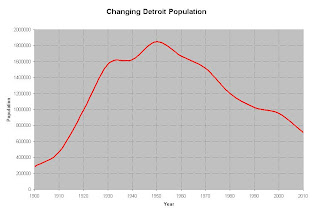
Detroit has been a classic bubble which peaked in 1950 and then busted (and is still in the bust stage). For the first few decades of the bust, the flight appeared to be just to the suburbs, but in the last couple of decades, the population of the region has been declining as well.
The demographics of Detroit have switched dramatically as well. At its peak in the 1950s, Detroit was a white town (84%). While the bust has been fueled primarily by "white flight" (Detroit has lost 1.5 million white people since 1950), between 2000 and 2010 the population of almost every group declined, so everyone realized that Detroit is not a place to live. The only group that saw an increase in population, Hispanics, only had a very minor increase.
So, imagine for yourself what the change of losing 55% of your population. Think of half of the homes in your neighborhood, half of the apartments in your complex being empty. Always. Its pretty easy to see why a home in Detroit can be bought for $5000.
With the decline of population of this magnitude, the number of school children will decline as well. Hence the need to close lots of schools. In our city, there was a big debate about closing 3 elementary schools last year. You would have thought that the government was shooting the dogs of random families with the rancor that was going on. Face it, there are less kids, so there is less need for schools. Massive population changes like Detroit has had compound the problem because you can't close schools gradually. And since they are funded through the property taxes of the homes that are vacant and abandoned, there is less money each year. But every school still needs to have some minimum level of funding for maintenance.

Overall, school age children have declined as a percentage of the overall population. Since 1981, we have about 15% less students as a percentage of the population. So, this should mean that we are spending 15% less as a percentage of GDP on education, right? Well, if logic prevailed, yes. But education spending is driven by the government and lobbied for by the Teacher's Unions. In 1981, 3.3% of the GDP was spent on K-12 education. In 2010, 3.6% was spent. That is 9% MORE! This is a recipe for bankruptcy.
This same logic has gotten the US Post Office in the mess we are in today. They are (hopefully) going to eliminate Saturday service. What they really need to do is eliminate Saturday, Tuesday, and Thursday service. The world has changed. People don't rely on the mail anymore.
Tuesday, February 12, 2013
Wisdom from Uncle Joe
What have we learned recently from the musings of Vice President Biden:
1) We have to pass "common sense" gun control measures for the children.
2) The gun control measures will do little to nothing to reduce crime or prevent another mass shooting.
3) There are government approved media outlets (legitimate news agencies) that we should get out information from.
4) No one is trying to take your guns.
So, knowing these things, we should shortly be hearing the Vice President speak out against the proposals in California and other places by elected officials to confiscate firearms. Then we will have licenses issued to the approved media so that we the people know who the government approves of. And, if the common sense is for the children and it will do little to nothing, than Obamacare probably won't improve access for those uninsured, it probably won't reduce the cost for those who have it, and it probably won't result in better care.
Maybe this is what the State of the Union is going to be about? Either that or jobs. Yeah, we sort of need those. Still. After 4 years.
Monday, February 11, 2013
No One is Proposing a Gun Confiscation
That is what I have been reading in the news for the last two months. It is what people on Facebook keep telling me. Its on the TV and the Radio. So it must be true.
California must not be no one. Because someone is proposing a confiscation. Sure it may not be anyone just yet, but it certainly isn't no one.
California must not be no one. Because someone is proposing a confiscation. Sure it may not be anyone just yet, but it certainly isn't no one.
Friday, January 18, 2013
New York Forgets About Police Officers
In New York's ram-em-through gun law, they forgot to include exemptions for their law enforcement officers. Seems once the law becomes effective, they will all be law breakers with their service pistols, issued by the government. The best quote though is below:
State Senator Eric Adams, a former NYPD Captain, told us he's going to push for an amendment next week to exempt police officers from the high-capacity magazine ban. In his words, "You can't give more ammo to the criminals"
NY doesn't want its police officers (who may arrive on the scene 1-20 minutes after being called) to face criminals with less than 15 rounds in a magazine, but it doesn't care if victims (who are already on the scene because they are the scene) only have 7 rounds.
Criminals vs. Police Officers - BAD.
Criminals vs. Victims - GOOD.
I sure hope Texas' plea to gun owners from NY to move there is effective.
Thursday, January 17, 2013
Good Luck New York! Hope Those Gun Laws Work Out for You...
While reading this, please keep in mind that the number of guns in the US has increased each and every year since at least 1965. Furthermore, it is estimated that the number of guns in the US is increasing at a faster rate than population such that now we (probably) have more guns than people. Read on...
New York became the first state to pass gun control legislation since the Newtown murders. Obama has made it known that he is signing executive orders to ... follow the laws that were already passed. Meanwhile he is also trying to get Congress to pass some of the same stuff that New York did. In a nutshell, New York is requiring the registration of existing assault weapons and banning their sale and transfer, and limiting magazine capacity to 7 rounds. Plus all of the grandfathered 10+ round magazines are no longer grandfathered, but must be disposed of within a year. All of this to decrease gun crime and make everyone safer. Of course, the law makers don't realize that they already had an AWB ban (the new one makes it a one cosmetic feature test rather than a two cosmetic feature test - and I am not being sarcastic about that, they are cosmetic features which do not affect the firepower of the rifle at all) and a magazine limit left over from the Federal AWB and magazine limits which expired in 2004.
First point to understand. Rifles are used in very few murders throughout the country and especially so in New York. Based on FBI statistics, all rifles (of which assault weapons are a subset) are used in about 1% of murders. There is enough variability from year to year that I can guarantee no affect to crime will be measured - because none can be, which is what was found with the last assault weapons ban.
Second point to understand. Magazines are used in handguns and handguns are used in the majority of murders. However, the vast majority of murders only have one victim, and the vast majority of the time, that victim is not shot more than 7 times. (Shots tend to attract attention and most criminals don't like to draw attention to themselves in the process of committing a crime.) I make these statements without citing evidence, because I haven't come across a source for this evidence. Which makes my statements just as supported as anyone who arbitrarily chooses a number that is going to make us safer and reduce crime. So, even if criminals decided to obey the magazine law, the law is not going to hinder them from carrying out their plans.
But, I like to see some sort of evidence to support my position, so I went and gathered data from the FBI Uniform Crime Reports. Since gun control laws are suppose to decrease gun crime, they should have a noticeable affect on the murder rate because approximately 70% of murders are committed with guns. The FBI has statistics going back to 1965 for NY.

Some things to learn from this graphic. First, in spite of the murder rate being 1/100 of overall violent crime rate, it is a very good proxy for what the violent crime rate is doing. The increases and decreases line up almost perfectly. In most cases the relative magnitude between periods is fairly uniform as well. Except that crimes committed with guns are a minority of violent crimes, only around 20% of violent crimes are committed with guns. If the availability of guns is a contributor to crime, then murder and violent crime should not be so closely correlated. Some other factor or factors have to be the impetus behind violent crime (and therefore gun crime).
Second, on the graph I have listed the major gun control legislation with bars indicating when it was in effect. If gun control were effective at reducing gun crimes, then we should see a drop in murders that is relationally 3 times the drop in violent crime when new gun control is implemented. We don't. In some cases we see the exact opposite. After the 1968 Gun Control Act, murders went up, but violent crime went up even more. One could argue that gun control in this case resulted in more crime and more murders, not a good thing in either case. In 1986, FOPA passed and violent crime and murders both went up again, with violent crime again outpacing the increases of murder. More evidence that gun control had no positive effect on our crime rates. In 1994 AWB were passed and crime went down. But violent crime (remember only 25% of it involves guns), went down proportionately more than murder rates did. Of course there were other provisions to this bill so perhaps they were the major contributors. Except that crime rates and murder had already been decreasing for 2-4 years prior to the passage of the bill, so maybe there wasn't anything to this bill (which is what the government found when they studied the issue). Finally, in 2004 we had an excellent opportunity for a test case. The Federal AWB ended, but NY kept theirs (including the magazine restriction to 10 rounds). If gun control really was effective, then we should see a dramatic difference between NY and the US as a whole. We didn't, more on that later.
Third, murder rates have remained relatively stable since 1998. Yes, there has continued to be a downward trend, but nothing like the upward or downward swings that the previous 30 years had had. Violent crime didn't reach a leveling off until 2004, but is also has seen relatively minor changes compared to the 30 previous years.
Fourth, while not on the chart, it is interesting to note that violent video games never even got off the ground until the early to mid 90s - the video graphics technology wasn't there before. By the time that the market was going strong in the late 90s, murder rates were already below anything seen since 1970. Perhaps this explains why we haven't seen a further drop, on the other hand, we haven't seen an increase either so if video games are to blame, then they certainly aren't doing too much.
Next, I expanded out to look at all of the types of violent crime. Some quick figures about gun usage based on Department of Justice Statistics. Guns are used to commit these crimes the following percentage of the time: murder 70%, rape 10%, robbery 40%, aggravated assault 20% (I just label it assault in the chart for simplicity). So, what I would expect from effective gun crime prevention legislation is that there should be little to no change in rape, barely noticeable in assaults, a noticeable change in robbery, and a significant change in murder.

This does not match that at all. Lets go through each one. I already pointed out how murder doesn't fit the mold for any of the gun control regulations passed. Next is rape, the type of violent crime that least uses guns in its commission. The US rape rate mirrors the violent crime rate. NY tracked the US rate up until the late 1970s and then leveled off (while the US rate continued it's rise). In the mid 80's, the NY rate started a decline which accelerated with the overall decline of violent crime in the early 90s. No evidence that gun legislation affected this in the least, which is expected. Rape rates move independent of gun control.
Up until the early 2000's, NY has had a robbery rate that far exceeded the US rate. In some years, NY's robbery rate exceeded the total violent crime rate for the nation. After gun control legislation passes, the robbery rate changes in the same manner as the murder rate or the violent crime rate, which is to say, it doesn't provide any supporting evidence that gun control works.
While having more assaults per 100,000 than the US as a whole for 30 years, NY finally crossed under the US curve in 1995. Of course, the results of gun control legislation match what occurred for the violent crime rate. Since 2008, assaults have climbed to match what the US rate is. Overall, the data doesn't match the hypothesis, so the hypothesis cannot be correct.
Earlier I mentioned that NY gave us a test bed by keeping their assault weapons ban and magazine restrictions. So, I looked a little closer at the last ten years in NY. Surely, if the AWB and magazine restrictions (which NY just made more stringent) had an effect it would show up here.

Not to beat a dead horse, but it hasn't. The only area that NY and the US are different in is assaults, and as I mentioned before, NY is on the rise. But, once rates get low enough, there are only going to be minor changes, so let me see if I can amplify those minor changes. I started by taking each rate from NY as a percentage from of the US (>100% means NY rate is higher than US, etc.). Next, I found the year to year change: negative numbers mean one of two things (both of which are in NY's favor) 1) the rate in NY is decreasing faster than the US rate (or crime is decreasing faster in NY than in the US) or 2) the rate in NY is increasing less than the US rate (or crime is increasing faster in the US than in NY). Likewise, positive numbers mean the opposite (bad for NY compared to the US).

I added a polynomial trendline in black and marked the end of the US AWB in red - remember, NY still has it. It appears that NY was seeing decreased crime (or less increases) compared to the US from 1974 to 2006. Neither one of those years correspond to a gun control legislation in their favor. If gun control legislation were effective, we should have seen greater negative numbers after the red line. Unfortunately for NY, since 2006 crime rates have been stagnant, while for the US it continues to decline. If this means that there is some threshold below which we cannot reduce crime rates for our society and NY has reached it, then any gun control legislation under the guise of reducing crime at this point in NY is a farce. As it is, there is ample evidence that gun control legislation to reduce crime is a farce under any circumstances.
But don't we need to do something? Why? If whatever we are proposing to do has already been shown to be ineffective, why burden the government with more laws to enforce or burden the people with more laws to break. But, what if one life were saved? One life hasn't been saved. There is no evidence that gun control has helped the crime situation. If you think that one life will be saved, show me the evidence.
On the other hand, what if I told you that there isn't a damn thing we can do about crime? What if I said that the primary cause of crime is so completely out of our control (because the solutions are horrifying to any sane person), that there is no point in trying. Playing around, I created the following graph that shows a pretty darn good correlation between something and violent crime.

In both NY and the US, the percentage of Males between the ages of 20 and 39 is one of the best predictors of the violent crime rate. I would have extended the graph all the way back to 1965, except I only could find reliable population demographic data back to 1981. The crime rates are from the FBI, the population data is from the CDC's WISQARS database.
We have long known that Males disproportionately are responsible for crime. We also know that the 20-39 age range is the most common age for violent crime offenders. For nearly 20 years in the US (and 17 years in NY), the violent crime rate (which is a proxy for murder rate and gun crime rate) is directly predictable by the ratio of males between the ages of 20-39. What is the solution? Lock up all men? Kill them all at 20? Drug them all into submission? I am talking about a stage in life that half of the population goes through for approximately 1/4 of their life. When the number of men in this age range is a higher percentage of the population, we have more violent crime. When it decreases, crime goes down.
Do I believe this is the major cause? I don't know, I stumbled across this while I was playing with other numbers and will have to do some more research. This is by far one of the closest approximations of estimating crime that I have found. It is far more predictive than the number of guns or the strength of the gun control laws. But people don't want to be told they can't do anything.
We want to control things. In the end, we can't. Life will go on.
Friday, January 14, 2011
9-Year Old VISA Violators
Because we have already solved our southern border problem, we now are able to focus on those kids whose grandparents are taking them to DisneyWorld. I mean, isn't it obvious that this kid from England is trying to sneak his way into the US (even though he didn't know it). Probably trying to establish himself as an anchor baby to bring the rest of his family over.
I have a few questions. Why was the 9-year old's VISA denied, but the grandparents were not? How old do you have to be to even have "strong ties outside the United States"? Is the bond between parents and children not considered strong enough? Does EuroDisney suck that bad?
This is where the Disney company should step in and show the world how generous they are. All expenses paid to EuroDisney, 5 star hotel, breakfast with Buzz Lightyear, the works.
Government Run Amok, Again
As many of you my know, I am not a proponent of government. I believe they have a few things (relatively few) that they should do, and should keep away from doing anything else. Besides that, as they grow in size (and in organization grows in size) the application of common sense decreases exponentially.
For instance, Houston doesn't want people to feed the homeless. This couple was not asking for a government handout and then embezzling the money, they were doing it out of their own compassion and the donations of those they contacted. Apparently food regulators demand that they get a permit and have the food prepared in a certified kitchen. The money quote:
The regulations are all the more essential in the case of the homeless, Barton said, because "poor people are the most vulnerable to foodborne illness and also are the least likely to have access to health care."
If you read that correctly, the government officials are saying that "its OK if the homeless starve, as long as they don't get a foodborne illness from someone's home kitchen." When faced with the choice of no food vs. food that has a low likelihood of having a foodborne illness, which would you choose?
While the regulators may defend that the regulations keep the public safe by ensuring that restaurants have appropriate cleanliness standards, I say BS. It is the customers that ensure that the restaurants have cleanliness standards (the regulators aren't at the restaurants every day or even every week). If a customer sees a roach crawling around on the floor, he is going to leave and probably tell all of his friends about it who then will not go to the restaurant. Hence, business is lost and unless the restaurant turns itself around, there will be no more restaurant. So it is in the restaurants best interest to maintain those high standards even without the regulators. The free market is a rapid and harsh punisher (of course the rewards are beyond compare).
It is a fact that home kitchens are several times less sanitary than restaurants. That being said, you don't see a neighbor dieing everyday from food poisoning. It is also a fact that garbage cans and dumpsters are several times less sanitary than the home kitchen, and usually not a good place to be scrounging food. But that is the option that Houston has provided for its homeless. (So I think that Houston - as in the government - should provide meals and shelter for the homeless? NO WAY. But stay out of the way of those people who do want to.
Subscribe to:
Posts (Atom)