I love to get a good deal. What most people don't realize is there is a lot of work involved to get a good deal. You may think that you are getting a good deal, but unless you have done your research, you probably just got what looks like a good price.
So how do I get good deals? First, I have to identify what is worth getting a good deal on. Milk may be $2.99 at WalMart but only $2.29 at Aldi. With that kind of minimal price difference, I am not going to go out of my way just to save 70 cents. It may be more in gas just to get there (although where I live right now, Aldi's is right next to Walmart). On the other hand, a quality dining room set may be $1200. If I can find something equivalent for $800 or less, then I have found a good deal. Finding a good deal starts with knowing what is worth looking for the good deals.
Second, you need to figure out what a reasonable price is and what you are willing to spend. These can be two separate things. For instance, $500 for an iPhone is reasonable. On the other hand, I am not willing to spend more than $200 since I wouldn't use it enough. Hence, I don't have a iPhone. Reasonable prices can be found by shopping (not buying). Stores, internet, and classified ads can all give you an idea of what things are selling for. The key here is to remember to factor in all of the costs (shipping and taxes). After seeing what a reasonable price for something is, it is now time to do the emotional decision and decide what you are willing to pay. It is important to set your price limit before you start looking for the good deal.
Third, the fun part begins - finding the good deal. This phase could take a day or years, depending on what you found in step two above. A good deal should be at least 25% less than what you are willing to pay (which hopefully is less than a reasonable amount). A lot of people stop when they find something less than their reasonable price and buy it then (even if it is only a few percent). Really, you should hold out for the good deal. Patience is key. While you made an emotional decision about what you are willing to pay, at this point emotion should no longer be a part of your decision. If the price isn't at least 25% less than your reasonable price, it's not a good deal.
Some may say that I am being stingy by trying to get such a low price. Actually, I am doing a net benefit to the economy. For one, by spending less money on each item, I am able to buy more, thereby spreading my dollars to more establishments. Second, a lot of the good deals happen on closeouts/inventory reductions/slightly damaged/etc. By me buying them, I am helping to clear out their inventory and giving merchants the chance to stock newer items. By me not buying more expensive items, I am allowing the supply to be available for those who just have to have the item at any price.
One of the great things about getting a good deal is you get to hear more sales pitches than ever before. I love salesmen, they have a job to do and their goal (in spite of what they may tell you) is to get you to buy as much as possible. Because of this it is always funny about some of the things that are told to you to "close the sale." I should start recording sales pitches to share some of the ridiculousness that is heard. Let me share some of them:
When we were shopping for a piano, the music store salesman told us that they were the "17th largest music store in the nation." I guess if you are in the 148th largest city in America, then this might mean something. Honestly, how "big" you are doesn't matter. What matters to me is price. I don't shop at WalMart because they are the largest retailer in the nation. I shop there because they have the right price for the things my family buys.
In looking for a hotel I am amazed that the rooms will be advertised with such amenities as a hairdryer or marble sink. 20 years ago, the major draw to motels (based on their advertising) was free HBO. The other thing that I laugh at is seeing them "brag" about their 250 thread count sheets or even 350 thread count sheets. I'm sorry, at home I sleep on 650 thread count sheets (and I don't want to go back to anything less - I splurged one year for our anniversary). If your business is going to brag about something, be sure that it is worth bragging about.
The last part of finding a good deal is to make sure you check the non-traditional places. Ebay & Craigslist are great resources. I once sold a pool table on Ebay for $350. It came with the house I bought and was really worthless to me. The person that bought it probably would have paid $600-$1000 for a new one. He got a good deal. I got it out of my house. Both of us were happy with the transaction. Another place my wife and I have found good deals is at Aldi's. We bought a breakfast nook (seats 6) for $170 (we had budgeted $700). I found out it is renamed from another company's brand which sells it under their label in department stores for $450-650. That breakfast nook has served us well for more than 5 years and still is going strong.
Shopping just to shop, I can't stand. Finding good deals while shopping I can handle.
Showing posts with label Economics. Show all posts
Showing posts with label Economics. Show all posts
Wednesday, March 27, 2013

Friday, March 15, 2013
The Cost of Universal Background Checks
The Senate now has a bill that would require universal background checks in the hope that this will keep guns out of the hands of criminals. While we can all admit that it won't keep all of the guns out of their hands (afterall, Great Britain's criminals have had no problem getting their hands on guns), we should ask ourselves two questions before considering whether this is a viable solution 1) How much is this going to cost (and to whom)? 2) How many guns is this going to keep out of criminals hands (and thereby how many crimes are averted)?
OK, that is 4 questions. And I haven't even brought up the 2nd Amendment. Let me look at this issue universally so that it could be applied whether there was a 2nd Amendment or not and whether people had a natural right to self defense or not. In other words, if it passes the "economics" test we can consider it and debate other issues, if it doesn't then there is no need to debate this further - i.e. it is unicorn rainbow farts.
Obviously, I am prejudiced. We all are. The dispicable ones are those who don't admit it. I am prejudiced for facts. I am prejudiced for truth. So, before you say that I am opinionated and discount my opinion, back up your opinion with facts.
Lets start with question 1) How much is this going to cost? Well, last year there were 19.5 million NICS background checks. Not all of these represent a single firearm purchase. Some of them are for carry permits. Some of them are for multiple firearms. Some states allow firearms to be bought with a carry permit without another NICS. This number averaged between 8 and 9 million from 1999 to 2005. It appeared to level off at 14 million in 2010, then election season came. The three highest months were Dec 2012, Feb 2013, and Jan 2013. So, if this keeps up all of 2013, we could see NICS checks of 25 million.
For simplicity sake, lets say the multiple gun sales cancel out the carry permit checks. Also, lets assume that NICS checks are artificially high. Therefore, I'll use 15 million firearm sales checks a year as the baseline. Now, the figure I have heard most bandied about is 40% of firearm sales are in the secondary market (i.e. no background check). Since this is an unregulated market of no records, there is really no way to verify this one way or the other. So without any other information, I'll accept this as is. Coincidentally, I did a tally of my firearms and just under 40% were bought on the secondary market.
So universal background checks will cover an additional 10 million sales. Now the states that already require all private transfers to go through an FFL as well as internet sales give us some idea of what the pricing will be. I have seen rates from $25 to $50 as the basic charge. So, I'll use $35 as the average.
How much is universal background checks going to cost? $350 million a year. This of course assumes that none of the transfers are exempted (which the current bill allows) and that the secondary market isn't depressed because of the increased cost (why would you buy a $75 used rifle if there is going to be a $35 mark-up when you can buy the same rifle from an FFL for $105). So let me cut this down to $200 million for a more realistic idea of what the price entails.
Which leads us to the next question 1a) Who is paying this? Well, that would be the people who are buying guns. What was the problem trying to be solved? Oh yeah, criminals getting their hands on guns. So, how does charging gun owners more money help decrease criminals getting their hands on guns?
Let's go to our next source of information, the Department of Justice report about Firearm Use by Offenders. This compared survey results of incarcerated criminals in 1991 (before background checks) and 1997 (after background checks). Now, I have taken the liberty to do some corrections because the background check requirement didn't go into effect until 1994. Also, some of the prisoners in 1991 would still be prisoners in 1997. So, I am going to assume that 100% of the prisoners from 1991 are still serving time in 1997, therefore, I'll subtract out their numbers from the 1997 numbers and re-calculate (there were significantly more prisoners in 1997 than in 1991, and significantly more prisoners that had firearms in 1997 than in 1991) ro get an approximate idea of how the background check requirement changed the procurement of firearms.
Assuming that all of the friends and family abide by the new law, and assuming each of the 500,000 crimes involving firearms each year represent unique individuals/firearm acquisitions, then 41,000 * $35 = $1.4 million will be paid by the people purposefully supplying firearms. $1.4/$200 million is 0.7% of the total cost will be shouldered by the portion of the population who may be responsible. 99.3% of the additional costs to this are paid for by law abiding gun owners. Can you imagine if we charged the everyone in the country $10 a year to pay for the costs of car accidents, regardless of whether they drove or not or how safe of a driver they were? That is what is being proposed here.
And a reminder for those anti-capitalists. All of this money is not going to crime prevention. All of it is going to FFL dealers. I don't fault them for charging whatever the law will allow. I fault the law for being stupid. Continuing on.
Question 2 How many guns is this going to keep out of the hands of criminals? Well, looking back at the chart above, the DOJ report provides evidence that prior to the background check requirement, 21% of criminals bought guns from retail outlets (I included flea markets and gun shows because they only made up 2% of this figure). After the background check requirement, it appears that the number dropped to 14%. Except that we have the problem of substitution. Because if you will notice Friends and Family had an increase of 6%. But that is a 1% difference still, right? Not quite, at the end of the report it identifies standard errors of up to 2%, for these numbers. So 6% and 7% for purposes of this report are essentially equal.
Remember though that a lot of those criminals in 1991 were still in prison in 1997, so if you look at my estimate, then yes, the background check was very effective at driving criminals away from both retail outlets and friends and family. So, the question then becomes did the number of guns decrease overall? Simply put, no. In 1997 there were 70% more prisoners than in 1991. Furthermore, those prisoners who had a firearm during their latest crime also went up (Table 3). If a larger percentage of criminals have firearms, you can't really argue that a particular gun control measure has been effective at reducing the number of guns criminals get a hold of.
Well, surely we can crack down on the Retail sales to criminals? No, because criminals are already prohibited from buying guns (whether retail or private party). The current background check already drove them out of the retail market. What about that 7.6% that are still buying from retail? Well, take a look at Table 7. 25% of inmates were first time offenders and 20% of them had a firearm for their most recent crime. Which means that they would have passed a background check so buying at retail was not a problem. 25% * 20% = 5%. Close to 7.6%, then if you recognize that using a fake ID and lying on the forms will also get you to pass a background check and the last 2.6% (if it isn't statistical noise anyway) is easily explained (Table 9 .
What about the family and friends aspect? Won't universal background checks prevent those people from providing guns? Probably not. Look at the table again. Using my estimate, the introduction of background checks also drove people out of the family and friends market. Why? Increased enforcement of straw purchaser laws, increased publicity of the fact that providing a firearm to a felon is illegal already. I don't know specifically since you would have to do a survey of family and friends of criminals. The fact remains though, friends and family who were selling firearms to criminals before the background check system were breaking the law. If they were willing to break the law before, what is going to prevent them from continuing to break the law.
Finally, it should be noted that the illegal market has shown that it can adequately supply the firearms needed by criminals. In 1991 it accounted for the largest percentage. In 1997 it was equal with Family and Friends (which had a significant rise). My estimate based on the DOJ numbers is that the illegal market is already supplying the vast majority of firearms, 84%. This market will be unaffected by the universal background check law.
In summary, universal background checks are going to cost about $200 million per year. They won't prevent criminals from getting guns and the vast majority of the cost will be paid by law abiding gun owners. Retail outlets already do not sell to criminals, and law abiding friends and family don't either (those that do are criminals themselves). The illegal gun market has always been a sizeable amount of the source of guns for criminals and could easily expand. So, universal background checks don't pass my simple economics test, therefore, it is a form of sniffing unicorn rainbow farts (don't worry while sniffing farts may not sound appealing, unicorns are imaginary and rainbows are just the reflection of light through droplets of water, in other words a mirage).
OK, that is 4 questions. And I haven't even brought up the 2nd Amendment. Let me look at this issue universally so that it could be applied whether there was a 2nd Amendment or not and whether people had a natural right to self defense or not. In other words, if it passes the "economics" test we can consider it and debate other issues, if it doesn't then there is no need to debate this further - i.e. it is unicorn rainbow farts.
Obviously, I am prejudiced. We all are. The dispicable ones are those who don't admit it. I am prejudiced for facts. I am prejudiced for truth. So, before you say that I am opinionated and discount my opinion, back up your opinion with facts.
Lets start with question 1) How much is this going to cost? Well, last year there were 19.5 million NICS background checks. Not all of these represent a single firearm purchase. Some of them are for carry permits. Some of them are for multiple firearms. Some states allow firearms to be bought with a carry permit without another NICS. This number averaged between 8 and 9 million from 1999 to 2005. It appeared to level off at 14 million in 2010, then election season came. The three highest months were Dec 2012, Feb 2013, and Jan 2013. So, if this keeps up all of 2013, we could see NICS checks of 25 million.
For simplicity sake, lets say the multiple gun sales cancel out the carry permit checks. Also, lets assume that NICS checks are artificially high. Therefore, I'll use 15 million firearm sales checks a year as the baseline. Now, the figure I have heard most bandied about is 40% of firearm sales are in the secondary market (i.e. no background check). Since this is an unregulated market of no records, there is really no way to verify this one way or the other. So without any other information, I'll accept this as is. Coincidentally, I did a tally of my firearms and just under 40% were bought on the secondary market.
So universal background checks will cover an additional 10 million sales. Now the states that already require all private transfers to go through an FFL as well as internet sales give us some idea of what the pricing will be. I have seen rates from $25 to $50 as the basic charge. So, I'll use $35 as the average.
How much is universal background checks going to cost? $350 million a year. This of course assumes that none of the transfers are exempted (which the current bill allows) and that the secondary market isn't depressed because of the increased cost (why would you buy a $75 used rifle if there is going to be a $35 mark-up when you can buy the same rifle from an FFL for $105). So let me cut this down to $200 million for a more realistic idea of what the price entails.
Which leads us to the next question 1a) Who is paying this? Well, that would be the people who are buying guns. What was the problem trying to be solved? Oh yeah, criminals getting their hands on guns. So, how does charging gun owners more money help decrease criminals getting their hands on guns?
Let's go to our next source of information, the Department of Justice report about Firearm Use by Offenders. This compared survey results of incarcerated criminals in 1991 (before background checks) and 1997 (after background checks). Now, I have taken the liberty to do some corrections because the background check requirement didn't go into effect until 1994. Also, some of the prisoners in 1991 would still be prisoners in 1997. So, I am going to assume that 100% of the prisoners from 1991 are still serving time in 1997, therefore, I'll subtract out their numbers from the 1997 numbers and re-calculate (there were significantly more prisoners in 1997 than in 1991, and significantly more prisoners that had firearms in 1997 than in 1991) ro get an approximate idea of how the background check requirement changed the procurement of firearms.
Reputo Estimate w/ NICS
|
DOJ FUO 1997 Inmates
|
DOJ FUO 1991 Inmates
| |
| Retail |
7.6%
|
13.9%
|
20.8%
|
| Friends/Family |
8.2%
|
39.6%
|
33.8%
|
| Illegal |
84.2%
|
39.2%
|
40.8%
|
Assuming that all of the friends and family abide by the new law, and assuming each of the 500,000 crimes involving firearms each year represent unique individuals/firearm acquisitions, then 41,000 * $35 = $1.4 million will be paid by the people purposefully supplying firearms. $1.4/$200 million is 0.7% of the total cost will be shouldered by the portion of the population who may be responsible. 99.3% of the additional costs to this are paid for by law abiding gun owners. Can you imagine if we charged the everyone in the country $10 a year to pay for the costs of car accidents, regardless of whether they drove or not or how safe of a driver they were? That is what is being proposed here.
And a reminder for those anti-capitalists. All of this money is not going to crime prevention. All of it is going to FFL dealers. I don't fault them for charging whatever the law will allow. I fault the law for being stupid. Continuing on.
Question 2 How many guns is this going to keep out of the hands of criminals? Well, looking back at the chart above, the DOJ report provides evidence that prior to the background check requirement, 21% of criminals bought guns from retail outlets (I included flea markets and gun shows because they only made up 2% of this figure). After the background check requirement, it appears that the number dropped to 14%. Except that we have the problem of substitution. Because if you will notice Friends and Family had an increase of 6%. But that is a 1% difference still, right? Not quite, at the end of the report it identifies standard errors of up to 2%, for these numbers. So 6% and 7% for purposes of this report are essentially equal.
Remember though that a lot of those criminals in 1991 were still in prison in 1997, so if you look at my estimate, then yes, the background check was very effective at driving criminals away from both retail outlets and friends and family. So, the question then becomes did the number of guns decrease overall? Simply put, no. In 1997 there were 70% more prisoners than in 1991. Furthermore, those prisoners who had a firearm during their latest crime also went up (Table 3). If a larger percentage of criminals have firearms, you can't really argue that a particular gun control measure has been effective at reducing the number of guns criminals get a hold of.
Well, surely we can crack down on the Retail sales to criminals? No, because criminals are already prohibited from buying guns (whether retail or private party). The current background check already drove them out of the retail market. What about that 7.6% that are still buying from retail? Well, take a look at Table 7. 25% of inmates were first time offenders and 20% of them had a firearm for their most recent crime. Which means that they would have passed a background check so buying at retail was not a problem. 25% * 20% = 5%. Close to 7.6%, then if you recognize that using a fake ID and lying on the forms will also get you to pass a background check and the last 2.6% (if it isn't statistical noise anyway) is easily explained (Table 9 .
What about the family and friends aspect? Won't universal background checks prevent those people from providing guns? Probably not. Look at the table again. Using my estimate, the introduction of background checks also drove people out of the family and friends market. Why? Increased enforcement of straw purchaser laws, increased publicity of the fact that providing a firearm to a felon is illegal already. I don't know specifically since you would have to do a survey of family and friends of criminals. The fact remains though, friends and family who were selling firearms to criminals before the background check system were breaking the law. If they were willing to break the law before, what is going to prevent them from continuing to break the law.
Finally, it should be noted that the illegal market has shown that it can adequately supply the firearms needed by criminals. In 1991 it accounted for the largest percentage. In 1997 it was equal with Family and Friends (which had a significant rise). My estimate based on the DOJ numbers is that the illegal market is already supplying the vast majority of firearms, 84%. This market will be unaffected by the universal background check law.
In summary, universal background checks are going to cost about $200 million per year. They won't prevent criminals from getting guns and the vast majority of the cost will be paid by law abiding gun owners. Retail outlets already do not sell to criminals, and law abiding friends and family don't either (those that do are criminals themselves). The illegal gun market has always been a sizeable amount of the source of guns for criminals and could easily expand. So, universal background checks don't pass my simple economics test, therefore, it is a form of sniffing unicorn rainbow farts (don't worry while sniffing farts may not sound appealing, unicorns are imaginary and rainbows are just the reflection of light through droplets of water, in other words a mirage).
Thursday, March 14, 2013
Economies of SodaStream
Soda Stream appears to be making a splash in the beverage market. I'm not much of a soda drinker so I don't know. It is a way to make your own carbonated beverages and hopefully save money. So, does it really save you money? As with all things, it depends.
There are three major costs to Sodastream. I used the Target website to find the information I needed to evaluate this. The initial machine is about $80 (although some models go up to $200) which comes with flavor packets and a carbonation tank. There are the carbonation tanks which run $15 and carbonate up to 60 L of drinks. And finally, there are the flavor packets which run from $5 to $12 for about 12 liters of servings. So then, how much soda does one have to drink to make this economical?
Now, like I said, I am no soda connoisseur, but I am pretty sure that those prices are much higher than what I can buy in the store. So I looked. Sure enough, name brands go for $1.50 to $2.50 for 2L bottles and generics for $0.50 to $1.50 for 2L bottles at the local grocery store. But the next question would be at what consumption is this economical?
That depends on the durability of the machine. The $1.50 for generics is broken at the 480 L level. Assuming a 3 year life, this is almost 7 Two liter bottles every month (our family maybe goes through 7 in an entire year - unless I am buying them for Mentos geysers in which case I'll go through 7 in about 5 minutes, but I digress). But that is the top of the generic price level. Unfortunately, because of the cost of the carbonator and flavoring, the cost for 2L will never be less that $1.33. For name brand it looks even worse, the flavoring and carbonator make the bottom price $2.50 per liter. So I would judge this as not that much of a money saver. It is almost always going to be cheaper to pick up your soda at the store - even with ridiculously high deposit fees.
Let me alter that statement: Unless you are accustomed to drinking premium sodapop, this is not a good buy. However, if you like the flavors or like to make other things carbonated, then have at it.
About 20 years ago, I was at a party where a friend had something similar. We were using it to make carbonated eggnog. It worked sporadically at best and made a mess when not used exactly right. I have no idea whether the Sodastream has similar problems. My guess is that the fad will wear out within a year or two as machines break down and people realize sugar, water, and carbon dioxide are REALLY cheap to mix together (which is why they have specials for 2L bottles as low as 33 cents!), ergo not worth the time to do it yourself.
There are three major costs to Sodastream. I used the Target website to find the information I needed to evaluate this. The initial machine is about $80 (although some models go up to $200) which comes with flavor packets and a carbonation tank. There are the carbonation tanks which run $15 and carbonate up to 60 L of drinks. And finally, there are the flavor packets which run from $5 to $12 for about 12 liters of servings. So then, how much soda does one have to drink to make this economical?
Total Liters Made
|
$5 flavor Cost / 2L
|
$12 flavor Cost / 2L
|
60
|
$ 3.50
|
$ 4.67
|
120
|
$ 2.00
|
$ 2.58
|
180
|
$ 1.78
|
$ 2.56
|
240
|
$ 1.67
|
$ 2.54
|
300
|
$ 1.60
|
$ 2.53
|
360
|
$ 1.56
|
$ 2.52
|
420
|
$ 1.52
|
$ 2.52
|
Now, like I said, I am no soda connoisseur, but I am pretty sure that those prices are much higher than what I can buy in the store. So I looked. Sure enough, name brands go for $1.50 to $2.50 for 2L bottles and generics for $0.50 to $1.50 for 2L bottles at the local grocery store. But the next question would be at what consumption is this economical?
That depends on the durability of the machine. The $1.50 for generics is broken at the 480 L level. Assuming a 3 year life, this is almost 7 Two liter bottles every month (our family maybe goes through 7 in an entire year - unless I am buying them for Mentos geysers in which case I'll go through 7 in about 5 minutes, but I digress). But that is the top of the generic price level. Unfortunately, because of the cost of the carbonator and flavoring, the cost for 2L will never be less that $1.33. For name brand it looks even worse, the flavoring and carbonator make the bottom price $2.50 per liter. So I would judge this as not that much of a money saver. It is almost always going to be cheaper to pick up your soda at the store - even with ridiculously high deposit fees.
Let me alter that statement: Unless you are accustomed to drinking premium sodapop, this is not a good buy. However, if you like the flavors or like to make other things carbonated, then have at it.
About 20 years ago, I was at a party where a friend had something similar. We were using it to make carbonated eggnog. It worked sporadically at best and made a mess when not used exactly right. I have no idea whether the Sodastream has similar problems. My guess is that the fad will wear out within a year or two as machines break down and people realize sugar, water, and carbon dioxide are REALLY cheap to mix together (which is why they have specials for 2L bottles as low as 33 cents!), ergo not worth the time to do it yourself.
Friday, March 8, 2013
My Tax Return Savings Account
It is interesting how the circumstances one finds oneself in can dramatically change their opinion of something. For instance, 15 years ago, I was adamantly against tax refunds. Not getting your money back, just the concept that people wouldn't pay enough attention to their finances such that they would receive thousands of dollars as a overpayment (or more likely an overwithholding) of taxes. At the time it was obvious to me that it was much more profitable to scrutinize and adjust your withholding on a regular basis (every couple of months) so that at the end of the year you were as close to breaking even as possible. I could put this money to work for me by investing it or at the very least put it in a savings account earning interest (as opposed to the interest free loan I would have been giving the government). I was pretty good at it for a few years, netting myself refunds of a couple hundred dollars or having to write a check for a couple of hundred dollars.
Then times changed. I started making more money and my taxes became more complicated. Now, at first glance one would think that making more money would be an incentive to implement my strategy above even more so. Afterall, 15 years ago, I was only making about $25K a year. My opinion on this issue has changed 180 degrees. Now, I would laugh in your face if you suggested the strategy above.
There are several factors that go into this. While there is some profit to be made from investment, it doesn't come without it's own cost, namely the time necessary to adjust your withholding (or in the case of quarterly tax filers, the amount of time - ergo rigor - into estimating the taxes owed). Couple this with exceedingly low interest rates and put a dollop of the ever changing tax code as politicians try to curry favor with this group or that group each year and you are left with a much more complicated task - so the rewards better be worth it.
In 2004 and 2005 I started a different job that had a significant amount of money made from bonuses and overtime. Because of tax law, this income was withheld at a higher rate (remember withholding, tax owed, and tax paid are completely separate concepts and not necessarily related). So, while my base pay was withheld at the legal minimum for federal income tax ($0), I was still being withheld on my bonus and overtime income. And there was no way to not have it withheld.
My time was also more valuable, while as a college student I might jump at the chance to earn $10-$15/hour, I was making much more than that. To put it in perspective, if my base rate was $30/hour and my boss wanted me to work overtime, he would have to compensate me for my time, usually at a rate of $45 per hour. So, in effect my leisure time was worth $45 per hour. On the other hand, if I wanted to make more money, I had to go and find that work and I might only be able to find something for $10-$15.
The only "extra" work I ever did during this time was I was an usher at Texas A&M football games. I was paid $50 per game (and I didn't have to spend $50 per ticket). I was able to see most of the game - in particularly the 4th quarter since my shift was done at the end of the 3rd. I did have to show up a couple of hours before the game, and the game was 3 hours, so figure about 5 hours total. For $50-$100 of value (since I would have bought tickets to go to the game anyway). And the first couple of hours, I brought a book or headphones to do what I normally would be doing at home. This was a great gig. To bad I didn't find out about it until my senior year.
So, only on rare occasions have I been willing to trade my leisure time for less than $25/hr. When faced with a job that was out to defeat my tax philosophy, I decided to evaluate and determine if it was worth it to find some way around it. Turns out, in my situation (and the vast majority of Americans situations), it's not worth it.
Let me illustrate. For the last 8 years, I have been getting tax refunds of $3000-$7000. Well above the national average of $2000 to $3000. The question one has to ask is what would you do with the money if instead of getting it in one big lump sum, you got a little bit more in every paycheck? Investing in the stock market historically has been the best performer. I assumed that I get a refund of $5200 each year (it makes it easily divisible by 26 paychecks a year). So each paycheck I would have a theoretical $200 to invest in the stock market (I'll use SPY the S&P 500 ETF).
Basically, at the end of the year, hopefully you have more money than you put in. Now, in order to game the tax withholding every couple of months you are going to need to go through and project what your tax return is going to look like at the end of the year (taking into account the money you have not yet made and the changes that the politicians have not yet proposed). Then you can adjust your withholding allowances/exemptions to change the amount that is withheld. Bear in mind that you probably want to err on the side of caution because while there is no bonus for having too much withheld, there are penalties for not having enough withheld. So, I conservatively assumed 10 hours per year spent analyzing and adjusting your tax withholding to calculate how much per hour this is equal to.
You can see from the list above, there are only three of the eight years in which crunching numbers for 10 hours a year would exceed my $25 free time price. Yours may be lower, but there were still three of eight years when the ROI was negative, so no amount of tinkering would have made it worth your time. Overall, $11.39/hour average doesn't sound too shabby - but remember, I make enough money to have $5200 refund each year, if you are only getting the national average of $2600, then cut this $11.39/hr in half and you have something that is less than minimum wage - in other words it would be more profitable for you to just go out and get a job at McDonalds for two days (five hour shifts) each year and then quit rather than try to monkey around with your tax withholding throughout the year.
But the 2005-2012 S&P line can be misleading. This is calculated by just adding up each of the yearly amounts. I did this since we plan our tax refund into our budget and mainly have it targeted to pay for big ticket items (replacing roof, buying car, etc.) that we know are happening in the next year. What about if you plan on saving this for the long term, there could be a lot of good benefits, right?
Well, the Combined column (assumes you don't spend it each year) is starting to look really good. $89/hr is a heck of a lot more than I make. Obviously, if the S&P 500 does average or even good in 2013, then this doesn't change the rosiness of this picture. But what if instead 2013 becomes another 2008?
So, I calculated for one more bad year, assuming that you spend it every year and it is bad, but if you were using it as long term savings, then that $89/hr turns into -$146/hr. In one year, of course the next year may be better than before. Or it could be worse. You don't really know, so, I would suggest not using this as the basis to make a decision. Don't get me wrong, I invest in the stock market and encourage others to as well. Its just not a place to put money that you may need in the short term.
So, let me look at something that is more stable, like bank interest rates. I can count on this to always be positive.
Nope, this certainly doesn't change things. Unless interest rates are astronomically high, there is no sense in me using my leisure time to play with taxes. In fact with some of these, I know my daughter has made more operating a lemonade stand.
So, for the last 8 years, my opinion has changed. At one point in my life the $25 extra a year in interest I might have made sense, but I had a whole lot of extra time back then. Yes, I have been giving the government an interest free loan for thousands of dollars, but on the flip side, the actions I would need to take to not give them that loan are not worth it. If there was no penalty for underpayment, then I wouldn't because it would make the decision easy (arrange to have nothing withheld and just write a check on April 15th).
Then times changed. I started making more money and my taxes became more complicated. Now, at first glance one would think that making more money would be an incentive to implement my strategy above even more so. Afterall, 15 years ago, I was only making about $25K a year. My opinion on this issue has changed 180 degrees. Now, I would laugh in your face if you suggested the strategy above.
There are several factors that go into this. While there is some profit to be made from investment, it doesn't come without it's own cost, namely the time necessary to adjust your withholding (or in the case of quarterly tax filers, the amount of time - ergo rigor - into estimating the taxes owed). Couple this with exceedingly low interest rates and put a dollop of the ever changing tax code as politicians try to curry favor with this group or that group each year and you are left with a much more complicated task - so the rewards better be worth it.
In 2004 and 2005 I started a different job that had a significant amount of money made from bonuses and overtime. Because of tax law, this income was withheld at a higher rate (remember withholding, tax owed, and tax paid are completely separate concepts and not necessarily related). So, while my base pay was withheld at the legal minimum for federal income tax ($0), I was still being withheld on my bonus and overtime income. And there was no way to not have it withheld.
My time was also more valuable, while as a college student I might jump at the chance to earn $10-$15/hour, I was making much more than that. To put it in perspective, if my base rate was $30/hour and my boss wanted me to work overtime, he would have to compensate me for my time, usually at a rate of $45 per hour. So, in effect my leisure time was worth $45 per hour. On the other hand, if I wanted to make more money, I had to go and find that work and I might only be able to find something for $10-$15.
The only "extra" work I ever did during this time was I was an usher at Texas A&M football games. I was paid $50 per game (and I didn't have to spend $50 per ticket). I was able to see most of the game - in particularly the 4th quarter since my shift was done at the end of the 3rd. I did have to show up a couple of hours before the game, and the game was 3 hours, so figure about 5 hours total. For $50-$100 of value (since I would have bought tickets to go to the game anyway). And the first couple of hours, I brought a book or headphones to do what I normally would be doing at home. This was a great gig. To bad I didn't find out about it until my senior year.
So, only on rare occasions have I been willing to trade my leisure time for less than $25/hr. When faced with a job that was out to defeat my tax philosophy, I decided to evaluate and determine if it was worth it to find some way around it. Turns out, in my situation (and the vast majority of Americans situations), it's not worth it.
Let me illustrate. For the last 8 years, I have been getting tax refunds of $3000-$7000. Well above the national average of $2000 to $3000. The question one has to ask is what would you do with the money if instead of getting it in one big lump sum, you got a little bit more in every paycheck? Investing in the stock market historically has been the best performer. I assumed that I get a refund of $5200 each year (it makes it easily divisible by 26 paychecks a year). So each paycheck I would have a theoretical $200 to invest in the stock market (I'll use SPY the S&P 500 ETF).
Value
|
$ Increase
|
% Increase
|
$/hr
| |
| 2005 S&P |
$5,355
|
$155
|
3.0%
|
$15.50
|
| 2006 S&P |
$5,613
|
$413
|
7.9%
|
$41.29
|
| 2007 S&P |
$5,177
|
($22)
|
-0.4%
|
($2.26)
|
| 2008 S&P |
$3,814
|
($1,386)
|
-26.7%
|
($138.61)
|
| 2009 S&P |
$6,265
|
$1,065
|
20.5%
|
$106.50
|
| 2010 S&P |
$5,729
|
$529
|
10.2%
|
$52.85
|
| 2011 S&P |
$5,184
|
($16)
|
-0.3%
|
($1.61)
|
| 2012 S&P |
$5,375
|
$175
|
3.4%
|
$17.46
|
| 2005-2012 S&P |
$42,511
|
$911
|
2.2%
|
$11.39
|
Basically, at the end of the year, hopefully you have more money than you put in. Now, in order to game the tax withholding every couple of months you are going to need to go through and project what your tax return is going to look like at the end of the year (taking into account the money you have not yet made and the changes that the politicians have not yet proposed). Then you can adjust your withholding allowances/exemptions to change the amount that is withheld. Bear in mind that you probably want to err on the side of caution because while there is no bonus for having too much withheld, there are penalties for not having enough withheld. So, I conservatively assumed 10 hours per year spent analyzing and adjusting your tax withholding to calculate how much per hour this is equal to.
You can see from the list above, there are only three of the eight years in which crunching numbers for 10 hours a year would exceed my $25 free time price. Yours may be lower, but there were still three of eight years when the ROI was negative, so no amount of tinkering would have made it worth your time. Overall, $11.39/hour average doesn't sound too shabby - but remember, I make enough money to have $5200 refund each year, if you are only getting the national average of $2600, then cut this $11.39/hr in half and you have something that is less than minimum wage - in other words it would be more profitable for you to just go out and get a job at McDonalds for two days (five hour shifts) each year and then quit rather than try to monkey around with your tax withholding throughout the year.
But the 2005-2012 S&P line can be misleading. This is calculated by just adding up each of the yearly amounts. I did this since we plan our tax refund into our budget and mainly have it targeted to pay for big ticket items (replacing roof, buying car, etc.) that we know are happening in the next year. What about if you plan on saving this for the long term, there could be a lot of good benefits, right?
Value
|
$ Increase
|
% Increase
|
$/hr
| |
| 2005-2012 S&P Yearly |
$42,511
|
$911
|
2.2%
|
$11.39
|
| 2005-2012 S&P Combined |
$48,765
|
$7,165
|
17.2%
|
$89.56
|
Well, the Combined column (assumes you don't spend it each year) is starting to look really good. $89/hr is a heck of a lot more than I make. Obviously, if the S&P 500 does average or even good in 2013, then this doesn't change the rosiness of this picture. But what if instead 2013 becomes another 2008?
Value
|
$ Increase
|
% Increase
|
$/hr
| |
| 2005-2012 S&P Yearly |
$42,511
|
$911
|
2.2%
|
$11.39
|
| 2005-2012 S&P Combined |
$48,765
|
$7,165
|
17.2%
|
$89.56
|
| One More Bad Year |
$46,325
|
($475)
|
-1.0%
|
($5.27)
|
| One More Bad Year Combined |
$33,580
|
($13,220)
|
-28.3%
|
($146.89)
|
So, I calculated for one more bad year, assuming that you spend it every year and it is bad, but if you were using it as long term savings, then that $89/hr turns into -$146/hr. In one year, of course the next year may be better than before. Or it could be worse. You don't really know, so, I would suggest not using this as the basis to make a decision. Don't get me wrong, I invest in the stock market and encourage others to as well. Its just not a place to put money that you may need in the short term.
So, let me look at something that is more stable, like bank interest rates. I can count on this to always be positive.
Value
|
$ Increase
|
% Increase
|
$/hr
| |
| 1% Savings |
$5,227
|
$27
|
0.5%
|
$2.71
|
| 2% Savings |
$5,254
|
$54
|
1.0%
|
$5.43
|
| 3% Savings |
$5,282
|
$82
|
1.6%
|
$8.18
|
| 4% Savings |
$5,309
|
$109
|
2.1%
|
$10.94
|
| 5% Savings |
$5,337
|
$137
|
2.6%
|
$13.72
|
Nope, this certainly doesn't change things. Unless interest rates are astronomically high, there is no sense in me using my leisure time to play with taxes. In fact with some of these, I know my daughter has made more operating a lemonade stand.
So, for the last 8 years, my opinion has changed. At one point in my life the $25 extra a year in interest I might have made sense, but I had a whole lot of extra time back then. Yes, I have been giving the government an interest free loan for thousands of dollars, but on the flip side, the actions I would need to take to not give them that loan are not worth it. If there was no penalty for underpayment, then I wouldn't because it would make the decision easy (arrange to have nothing withheld and just write a check on April 15th).
Wednesday, February 20, 2013
Tax Hike Doesn't Increase Revenue
Greece has given us the latest example of something that has been obvious to people throughout time. Tax increases do not necessarily increase revenue. Yes, it is true if tax rates didn't affect people's behavior and if no one took them into account, then increasing tax rates would increase revenue. But taking this logic to its extreme, a tax rate of 100% should bring in 100% of the revenue for the country.
This statement is true only if we consider "legal" revenue. There are lots of other competing factors in any market (regardless of how much control the government has on it). People don't work to support the government. I haven't met one yet. Warren Buffet and others may say they are not taxed enough, but they aren't beating down the doors of the Treasury department to give their excess money either. Actions speak louder than words.
There is a cash economy that is completely untouched by federal taxes. This includes the kid who mows your lawn, your piano teacher, and even tipping at some restaurants. These people engage in legal business but don't report the income even though many of them are required to. There is no way to track this money and the best that we can do is estimate how large it is. All of the estimates I have seen are in the hundreds of billions and in a few are $1-3 trillion (with GDP around $15 trillion, this is a significant amount). Other than taxes these markets are relatively harmless.
Then there are the various black markets. Markets of illegal activities. They exist for everything from drugs, guns, prostitutes, child porn, endangered species, etc. People in these markets are not subject to government regulation or the legal system to settle disputes. They have lots of costs on society. First, the law enforcement cost to find and prosecute these people, second the harm caused to people unrelated to the markets who are affected since there is no legal structure to insulate them.
Whenever tax rates/regulation changes money will flow to or from these other markets. At a 100% tax rate, the black market would blossom (and probably involve more barter) and the cash economy would also flourish (although those who formerly received all of their income from this economy may take a significant hit because now nearly everyone would be involved in the cash economy). No one would want to work for "legal" money since they wouldn't keep any of it. So, traditional business would grind to a halt overnight. This would not be good for the economy.
Changing tax rates (particularly targeted to wealthy people or on voluntary transactions) also can have large effects as their behavior changes. For instance, when the capitol gains tax rate was reduced, more capital gains were taken, so much so that the reduction in tax rate ended up generating more revenue than the higher rate did. Conversely, luxury taxes on things like yachts did nothing but destroy the yacht building industry. Sure the middle class and poor don't buy yachts, but they work for the yacht manufacturers.
Governments use a static model for projecting tax revenues. This is wrong. Sure it would be a lot more complicated to use a dynamic model that actually takes peoples actions into account, but lots of things are difficult and complicated and we still do them. We put a man on the moon for crying out loud. With slide rules.
This statement is true only if we consider "legal" revenue. There are lots of other competing factors in any market (regardless of how much control the government has on it). People don't work to support the government. I haven't met one yet. Warren Buffet and others may say they are not taxed enough, but they aren't beating down the doors of the Treasury department to give their excess money either. Actions speak louder than words.
There is a cash economy that is completely untouched by federal taxes. This includes the kid who mows your lawn, your piano teacher, and even tipping at some restaurants. These people engage in legal business but don't report the income even though many of them are required to. There is no way to track this money and the best that we can do is estimate how large it is. All of the estimates I have seen are in the hundreds of billions and in a few are $1-3 trillion (with GDP around $15 trillion, this is a significant amount). Other than taxes these markets are relatively harmless.
Then there are the various black markets. Markets of illegal activities. They exist for everything from drugs, guns, prostitutes, child porn, endangered species, etc. People in these markets are not subject to government regulation or the legal system to settle disputes. They have lots of costs on society. First, the law enforcement cost to find and prosecute these people, second the harm caused to people unrelated to the markets who are affected since there is no legal structure to insulate them.
Whenever tax rates/regulation changes money will flow to or from these other markets. At a 100% tax rate, the black market would blossom (and probably involve more barter) and the cash economy would also flourish (although those who formerly received all of their income from this economy may take a significant hit because now nearly everyone would be involved in the cash economy). No one would want to work for "legal" money since they wouldn't keep any of it. So, traditional business would grind to a halt overnight. This would not be good for the economy.
Changing tax rates (particularly targeted to wealthy people or on voluntary transactions) also can have large effects as their behavior changes. For instance, when the capitol gains tax rate was reduced, more capital gains were taken, so much so that the reduction in tax rate ended up generating more revenue than the higher rate did. Conversely, luxury taxes on things like yachts did nothing but destroy the yacht building industry. Sure the middle class and poor don't buy yachts, but they work for the yacht manufacturers.
Governments use a static model for projecting tax revenues. This is wrong. Sure it would be a lot more complicated to use a dynamic model that actually takes peoples actions into account, but lots of things are difficult and complicated and we still do them. We put a man on the moon for crying out loud. With slide rules.
Wednesday, February 13, 2013
Detroit Schools
This story is two years old, but it is still applicable to lots of other things. To begin look at what the population of Detroit has been doing for the last 100 years:
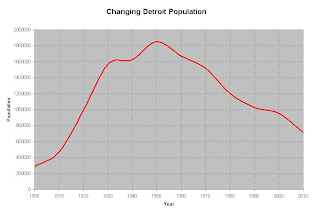
Detroit has been a classic bubble which peaked in 1950 and then busted (and is still in the bust stage). For the first few decades of the bust, the flight appeared to be just to the suburbs, but in the last couple of decades, the population of the region has been declining as well.
The demographics of Detroit have switched dramatically as well. At its peak in the 1950s, Detroit was a white town (84%). While the bust has been fueled primarily by "white flight" (Detroit has lost 1.5 million white people since 1950), between 2000 and 2010 the population of almost every group declined, so everyone realized that Detroit is not a place to live. The only group that saw an increase in population, Hispanics, only had a very minor increase.
So, imagine for yourself what the change of losing 55% of your population. Think of half of the homes in your neighborhood, half of the apartments in your complex being empty. Always. Its pretty easy to see why a home in Detroit can be bought for $5000.
With the decline of population of this magnitude, the number of school children will decline as well. Hence the need to close lots of schools. In our city, there was a big debate about closing 3 elementary schools last year. You would have thought that the government was shooting the dogs of random families with the rancor that was going on. Face it, there are less kids, so there is less need for schools. Massive population changes like Detroit has had compound the problem because you can't close schools gradually. And since they are funded through the property taxes of the homes that are vacant and abandoned, there is less money each year. But every school still needs to have some minimum level of funding for maintenance.

Overall, school age children have declined as a percentage of the overall population. Since 1981, we have about 15% less students as a percentage of the population. So, this should mean that we are spending 15% less as a percentage of GDP on education, right? Well, if logic prevailed, yes. But education spending is driven by the government and lobbied for by the Teacher's Unions. In 1981, 3.3% of the GDP was spent on K-12 education. In 2010, 3.6% was spent. That is 9% MORE! This is a recipe for bankruptcy.
This same logic has gotten the US Post Office in the mess we are in today. They are (hopefully) going to eliminate Saturday service. What they really need to do is eliminate Saturday, Tuesday, and Thursday service. The world has changed. People don't rely on the mail anymore.

Detroit has been a classic bubble which peaked in 1950 and then busted (and is still in the bust stage). For the first few decades of the bust, the flight appeared to be just to the suburbs, but in the last couple of decades, the population of the region has been declining as well.
The demographics of Detroit have switched dramatically as well. At its peak in the 1950s, Detroit was a white town (84%). While the bust has been fueled primarily by "white flight" (Detroit has lost 1.5 million white people since 1950), between 2000 and 2010 the population of almost every group declined, so everyone realized that Detroit is not a place to live. The only group that saw an increase in population, Hispanics, only had a very minor increase.
So, imagine for yourself what the change of losing 55% of your population. Think of half of the homes in your neighborhood, half of the apartments in your complex being empty. Always. Its pretty easy to see why a home in Detroit can be bought for $5000.
With the decline of population of this magnitude, the number of school children will decline as well. Hence the need to close lots of schools. In our city, there was a big debate about closing 3 elementary schools last year. You would have thought that the government was shooting the dogs of random families with the rancor that was going on. Face it, there are less kids, so there is less need for schools. Massive population changes like Detroit has had compound the problem because you can't close schools gradually. And since they are funded through the property taxes of the homes that are vacant and abandoned, there is less money each year. But every school still needs to have some minimum level of funding for maintenance.

Overall, school age children have declined as a percentage of the overall population. Since 1981, we have about 15% less students as a percentage of the population. So, this should mean that we are spending 15% less as a percentage of GDP on education, right? Well, if logic prevailed, yes. But education spending is driven by the government and lobbied for by the Teacher's Unions. In 1981, 3.3% of the GDP was spent on K-12 education. In 2010, 3.6% was spent. That is 9% MORE! This is a recipe for bankruptcy.
This same logic has gotten the US Post Office in the mess we are in today. They are (hopefully) going to eliminate Saturday service. What they really need to do is eliminate Saturday, Tuesday, and Thursday service. The world has changed. People don't rely on the mail anymore.
Thursday, January 24, 2013
Romney's Taxes vs. my taxes
Since tax season is coming up, I felt inspired to post this bit I had previously posted on Facebook.
To begin, let me iterate that I fall into the top 15% of wage earners based on reported AGI in table 488 ofhttp://www.census.gov/compendia/statab/2012/tables/12s0488.pdf . Lest you think that makes me a millionaire, the top 3% make $200,000 or more (so I wouldn't even fit Pres. Obama's definition of millionaire). So I have admitted that I make less than $200K. Now going back on my tax returns to 2001, I averaged my federal taxes (income and payroll), state taxes, and charitable contributions.
Why include payroll taxes (SS and Medicare)? Because in the end it is money going to the federal government to finance our nation. Mr. Romney probably pays nothing into SS and Medicare because (if you look at his return) he has no ordinary income (line 7 Wages, salaries, and tips). At 7.65% (5.65% currently), this is by far the biggest tax bite that workers in America pay (and if you include the employer portion, you can double that number to 15%). So, without refundable credits, you are automatically paying an effective tax rate of 7.65% if your income is primarily derived from ordinary income.
Anyway, my effective federal tax rate remained around 12% from 2001 to 2007. In 2008, it dropped to 7% (this would have been under Bush II). And then in 2009 and 2010 it was down to 6%. So, not only does Mr. Romney pay 2.5X an effective tax rate as me, he also pays about $3 million more than me. Can't say I have anything to complain about there. Besides, my tax return is only about 20 pages, not the 200 that Mr. Romney has to do. And I still do my own taxes, so I am not paying an accountant a few grand.
My state tax (when I lived in a state that has an income tax) has remained fairly stable at 4.5%. I have no desire to try and figure out what Mr. Romney's rate is. Nobody seems to care. They only care about his Buffet rate.
As for charitable contributions, mine have remained between 10% and 15%. This is right in-line with the 13.7% that Mitt donates to charity. So, maybe I should like Romney after all.
Having done my own taxes for my entire life, I would guess that the only people who are paying more than a 15% effective tax rate are those that fall into the 1% (according to IRS statistics those with income of about $350K) that the Occupy movement rails against. The exception would be single or married with two incomes who make between $100K and $350K. But even then, we are still talking about less than 7% of the population. If you make less than $100K and are paying an effective tax rate of more than 15%, you haven't figured out how to do your taxes. Get some advice from an accountant, and follow it.
So, have you ever bothered to figure out what your effective tax rate is? (Hint: It is not as easy as taking your paycheck withholding and dividing it by your income.)
Wednesday, January 23, 2013
Progress - It's Why We're Here Today!
Another great news article. JC Penney will finally follow the lead of lots of other stores and eliminate (mostly) their check out clerks replacing them with self serve kiosks. Naturally, some people are concerned that this is going to cost people jobs.
Yes. By golly gee willikers it will! And that is what JC Penney needs to do to survive. Cut out the expensive employees, so they can make money again. Because if they aren't making money and have no forseeable chance of making money in the future, then they might as well shut down.
People happen to be a BIG expense. Take the phone system. We used to employ thousands of operators to direct calls all over the country. Then the computer came about and pretty soon we were able to place calls all over the world and all of those (or most of them) operators lost their jobs.
And it was GREAT! Not because they lost their jobs, but because we were able to remove thinking humans from a mundane task that can be satisfactorily performed by a computer at a fraction of the cost. This has two benefits. #1 the customer can call anywhere for a whole lot cheaper (phone calls now cost a fraction of what they did just 25 years ago and we make far more of them) and #2 that thinking human has the option to use their brain for more creative/inventive/entrepreneurial work (like figuring out how a computer can get rid of the next mundane task).
This is called progress, we have been doing it for about 10,000 years since our hunter/gatherer forebears figured out they could produce a lot more through agriculture and husbandry. Of course, if you still want to make toothpicks by hand, be my guest. I happen to like my spare time to play video games (you know, those things thinking humans invented for our entertainment).
JC Penney, welcome to the 21st Century!
Yes. By golly gee willikers it will! And that is what JC Penney needs to do to survive. Cut out the expensive employees, so they can make money again. Because if they aren't making money and have no forseeable chance of making money in the future, then they might as well shut down.
People happen to be a BIG expense. Take the phone system. We used to employ thousands of operators to direct calls all over the country. Then the computer came about and pretty soon we were able to place calls all over the world and all of those (or most of them) operators lost their jobs.
And it was GREAT! Not because they lost their jobs, but because we were able to remove thinking humans from a mundane task that can be satisfactorily performed by a computer at a fraction of the cost. This has two benefits. #1 the customer can call anywhere for a whole lot cheaper (phone calls now cost a fraction of what they did just 25 years ago and we make far more of them) and #2 that thinking human has the option to use their brain for more creative/inventive/entrepreneurial work (like figuring out how a computer can get rid of the next mundane task).
This is called progress, we have been doing it for about 10,000 years since our hunter/gatherer forebears figured out they could produce a lot more through agriculture and husbandry. Of course, if you still want to make toothpicks by hand, be my guest. I happen to like my spare time to play video games (you know, those things thinking humans invented for our entertainment).
JC Penney, welcome to the 21st Century!
Thursday, January 17, 2013
Why Do We Still Have the Dollar Bill?
I've said in the past get rid of the dollar bill. While this is probably the 20th time in the last 50 years that Congress has looked at the proposal, perhaps we will have some sense this time and do it. Don't bet the house on it (when has Congress made a fiscally sound decision in the last decade), but I'm hoping for a long shot here!
One thing why you shouldn't get your hopes up - the Treasury is finishing up an 18 month study of this issue. Whatever money we spent on this study is a complete and utter waste. Several countries have gotten rid of their $1 bills, and not just third world banana republics - trading partners like Canada, England, and even the Eurozone have recognized for decades that the $1 bill was a money waster.
One thing why you shouldn't get your hopes up - the Treasury is finishing up an 18 month study of this issue. Whatever money we spent on this study is a complete and utter waste. Several countries have gotten rid of their $1 bills, and not just third world banana republics - trading partners like Canada, England, and even the Eurozone have recognized for decades that the $1 bill was a money waster.
The fact that we are behind several third world countries who don't have reliable running water or electricity is an embarrassment. If we really need a study, we should have asked the Canadians for their 30 year old study and then relabeled it - total price $100K. If the study from 30 years ago showed that it was cheaper back when everyone carried money, it is going to be that much more cheaper now that hardly anyone carries money.
If it is the metal composition, we are also behind the eight ball. Since we stopped putting precious metals in coins in the 60s, we should have immediately gone to the cheapest metals possible. No sense in trying to pretend like the money has melt value. Once again, several other countries (including many banana republics) have done this. While I am not too keen on steel from a collector's standpoint, it is very practical. I'd prefer a chrome steel or nickel steel alloy that doesn't rust. Cupronickel is good (what our nickels are made from) but expensive. If we wanted to stick with this then get rid of the penny, nickel and quarter and just have dimes and half dollars (then no one will get the dollar confused with the quarter). Several countries use a stainless steel alloy which remains nice and shiny decades later.
So, if all of these other countries have been able to figure this out, why do we need to spend 18 months and millions of dollars on a study to come up with the same answer? And people wonder why we are adding $1 trillion in debt each year. Easy, just take this philosophy and magnify it by every item in the federal budget.
One area of the economy that would be affected is strip clubs. I am not sure strippers would like to be pelted with dollar coins for their performance. However, this could easily be solved by the strip clubs printing their own bills and then patrons can purchase a bundle upon entering. The workers would then turn in their gathered bills at the end of their work day for real money. (Sure, this would eliminate a lot of the under the table transactions that probably go on, but that would mean more tax dollars - its a good thing!) Disney does this as sort of a souvenir gimmick (or at least they did 30 years ago). I have Disney Dollars (with portraits of Mickey and Goofy) that can be used as real money in the Disney themeparks, but have no value elsewhere.
One area of the economy that would be affected is strip clubs. I am not sure strippers would like to be pelted with dollar coins for their performance. However, this could easily be solved by the strip clubs printing their own bills and then patrons can purchase a bundle upon entering. The workers would then turn in their gathered bills at the end of their work day for real money. (Sure, this would eliminate a lot of the under the table transactions that probably go on, but that would mean more tax dollars - its a good thing!) Disney does this as sort of a souvenir gimmick (or at least they did 30 years ago). I have Disney Dollars (with portraits of Mickey and Goofy) that can be used as real money in the Disney themeparks, but have no value elsewhere.
Saturday, January 12, 2013
Hedge Fund Manager Ackman Goes in the Ring Against Herbalife
In recent investing news, I have been following the kerfluffle between hedge fund manager Bill Ackman (who I'll admit I had never heard of before, but I don't follow hedge funds) and Herbalife, a corporation that sells weight loss shakes and business opportunities to sell weight loss shakes (I'll admit, while I don't know exact details about this company, I am familiar with their business model and have studied it extensively).
Back in December, Ackman made a presentation to some investors where he laid out his case that Herbalife is running an illegal pyramid scheme and will be shut down by the FTC. As part of this he announced that he had taken a short position of $1 billion with a price target of $0. In other words, he doesn't have any intention of covering his short because he beliefs the company will be shut down by the FTC. Herbalife has responded to this presentation with their own during they recent investor phone call. Depending on which side you are on, the news seems to indicate that this response was either a slam dunk or an airball.
In a nutshell, Ackman's presentation goes over the funny math that Herbalife uses, which, in their estimation, shows that Herbalife distributors make more money from recruitment than they do from retail sales of their product. I have gone through their presentation, and I find their logical argument rather impressive. But there were some numerical errors that I found along the way. So let me go through those.
First, on slide 10 and 11 of the presentation linked to above, it compares Herbalife to other consumer product companies like Church & Dwight, Energizer, and Clorox (as a disclaimer, I own Clorox stock and have for about 12 years). The problem I have with this comparison can be easily seen on the slide 11, is that all of these companies have several brands that span the spectrum of consumer buys: cleaning products, food, clothing, cosmetics, etc. I was familiar with almost all of the brands, even if I didn't know what the parent company name was (Church & Dwight has Arm&Hammer, Nair, Trojan, and Xtra).
One of the things that Ackman brings up is even though all four of these companies are similar in size and in the consumer products brand, Herbalife is a relative unknown. I can think of two reasons for this. 1) Herbalife primarily sells a narrow segment of the consumer products market, namely health and wellness products and advertises by word of mouth (this is a segment that I don't use much products in so am not very familiar with) and 2) although similar size to the other three, Herbalife sales are primarily international. So, I thought I would test these hypothesis. Since all four are publically traded the information I need is right there in their filings to the SEC.
Below is the information that I gleaned from the SEC EDGAR site of filings. Dollars are in millions. I looked at the last quarterly report available for each company.
In a nutshell, my two hypothesis are correct. Herbalife is more concentrated in sales in a single segment than any of the other three. And Herbalife relies on International sales far more than any of the other companies. Neither of these is inherently bad, it just shows that Ackman's comparison wasn't the best comparison. Whether or not there actually are more similar companies to compare it to, I don't know, I'll leave that to his paid researchers to figure out.
Second, slide 12 identifies Herbalife as a $2 billion brand that no one has heard of. Ackman explains how he comes up with this number, 29% of total product then adjusting for shipping costs and Herbalife's revenue/discount reporting. I just use the 29% and look at their total sales and come up with $853 million. So, less than $1 billion brand. Furthermore, as shown above, most of these other brands probably have 50%-75% of their sales in the US, while Herbalife only has 20%, so their Formula 1 shake is only a $170 million brand in the US.
Third, slide 14 shows that Herbalife sells more powder drink mix. Except does it really. They sell more $ wise. He doesn't include the premixed liquids, although I will all together since Herbalife doesn't offer it and my guess is if they did then their powder sales would decrease and liquid sales increase. I didn't bother to look up the actual amounts for the other brands but assumed that Ensure and Slimfast had 60% sales in the US and GNC had 90%.
This is more evidence why Herbalife is relatively unknown. No matter which numbers you believe, Herbalife isn't the most popular weight loss shake. But lets look at these numbers in another way. How many servings of each are actually sold? Ackman gives us the information needed on slide 16.
Sales and servings are in millions and it looks like Herbalife has an even smaller market share on a serving basis than before. So to answer the question, why is Herbalife a relative unknown in the US? Because for every 1 person drinking their shake, there are 6.25 people drinking these other three brands. This isn't even all of the brands available. A quick look on the internet found that Walmart has a weight loss shake - the Equate brand which is cheaper than any of the ones that Ackman lists (disclosure, I also own stock in Walmart and have for 6 years). I doubt I could easily find sales of this brand shake, but it is possible that it and many others are a significant player on the weight loss shake market.
Fourth, slide 21 states that Herbalife products are commodities and lists several competing brands. This in and of itself isn't enough for me to say that Herbalife is a commodity as opposed to a premium product like they claim. So, I compared the nutrition label for the above Walmart weight loss shake to the Herbalife shake. Guess what I found? Yep, basically identical (when the powder is mixed with 8 oz nonfat milk). Herbalife has less fat and more protein, and a few of the nutrients are different. Walmart has a full day supply of Vitamin C and Vitamin E while Herbalife only has 25%. Comparing the ingredients, Herbalife has soy protein (accounting for the extra protein) and that is about it. So, unless you want to pay a hefty premium (up to $2 a serving) for that extra 7 grams of protein, you would be just as well off buying the Walmart brand. And after looking at this, I can agree with Ackman that Herbalife is not a premium product, just a premium price.
That is about all of the problems, that I see. I think Bill Ackman could have made a stronger case by comparing with more appropriate companies. That being said, Herbalife has responded and there are some issues I have with how they play with the numbers.
In response to Ackman, Herbalife touted the information from a customer survey they had done by Lieberman Research Worldwide (another company I have never heard of, but there isn't any reason for me to necessarily). During an interview on CNBC, the CEO implies that 90% of their product is sold to people outside of the distributor network. On the other hand, the 3rd Quarter conference call that Herbalife had and is referenced in the report linked above states that 90% of customers are outside of the distributor network. These are two very different things. So are one, both, or neither of them correct?
Let's do some more looking. We know that this survey was conducted in the US so we'll try to confine ourselves to that market. However, much of the information in the quarterly report for Herbalife is for the North American market. Fortunately for us, Mexico is not part of that reporting and the numbers for North America are only a few percent higher than for the US by itself (i.e. $209 million revenue vs. $202 million). That being said, I'll use North America as a proxy. $ figures are in the millions.
So, here is the first bit of information. The Active Sales Leaders qualify to buy product at a 50% discount. All other distributors can only buy at a 25%, 35% or 42% discount. Retail sales is the recommended retail sales price and distributor allowance is the discounted amount of retail sales. So net sales is then retail sales minus distributor allowance plus shipping charges. The first thing that can be seen is that a significant amount of sales is from active sales leaders (this would be expected). To determine exactly how much, I'll just assume there is only two discounts 50% and 25%. Using a little algebra this equates to 90% by Active Sales Leaders and 10% by the rest (so it follows the Peter Principle).
Getting back to the Lieberman report for a minute. They found 5.5 million customers from the past 3 month period, over 90% were not in the distributor network, and 2/3 were likely to buy again. With only 372,000 distributors total in North America, if there are 5.5 million customers, then of course 90% are outside of the distributor network.
Next I'll assume that all of the non active distributors (305,000) are only in it for personal consumption, this is somewhat implied in the Herbalife filings. 10% of $332 million is $33.2 million in retail product sales over a 3 month period. Divide this by the distributors and you have $109/ quarter or $36/mo. This is equivalent to a single 750 g bottle of the Formula 1 shake powder (30 servings). Herbalife recommends 1 serving a day for weight maintenance and 2 servings a day for weight loss. So, none of these distributors are using the product for weight loss, or there are a significant number of them that don't use the product regularly, or (considering Herbalife sells several products) using some algebra again 25% use $100 per month (Herbalife recommended), 20% use $39 per month (one bottle), 25 percent use $39 per quarter, and 30% use $39 per year.
So, if people are becoming distributors just for personal consumption, they certainly aren't consuming a whole lot.
Next we have the 68,000 active Sales Leaders who are buying $300 million retail (for $150 million) each three months. And there are roughly 5.1 million customers that are buying from these distributors if all of the numbers are correct. To begin, that is 75 customers per distributor (which is 3 times the amount from the Herbalife plan - slide 58), however, it amounts to only $1470 per month in retail (which is a little more than half of what the Herbalife plan shows of $2500/month). So at a minimum, the standard sales pitch of the opportunity should be updated to reflect what is actually happening, of course, it is kind of hard to get someone to buy in to finding 75 regular customers. If you figure there is one hour spent per quarter on each customer, plus meetings and other Herbalife related stuff, you have a full time job!
If there are 5.1 million real customers, what are they buying? Let's assume that the 68,000 distributors also have a personal use of $100 retail per month (as recommended by Herbalife), that leaves $280 million being purchased by the customers - $55 per quarter. So, that translate to two of the smaller bottles per quarter (not per month per quarter). In other words, the customers aren't using it for weight loss or maintenance. Which means if these are the real customers of Herbalife, then Herbalife doesn't understand how its products are being used by the public. To answer the other statement from Herbalife, Sales Leaders are buying $20million per quarter for personal use (if they are using $100 per month) and all other distributors are buying $33 million per quarter for personal use. Which means that the distributor network accounts for at least 16% of all sales, so no 90% of Herbalife product is not sold outside of the distributor network. If it is, then the distributors themselves don't believe in the product enough to use it.
The last funny bit of numbers that I wanted to look at is one of the "X has more A than M, B than N, C, than P..." So I used the USDA food information database to find out what is in each of the items listed on the Formula 1 sales page.
Let's go through the claims one at a time. "More Vitamin A than a Mango." Yes, but I never thought of mangoes as a Vitamin A food, compared to carrots, it only has half as much Vitamin A. And a mango will give you all of the Vitamin C that you need for a day.
"More Vitamin C than a Banana." Again, when did bananas become a vitamin C food? Yes, the statement is true, but since we already got almost 4 times the vitamin C from the mango, it is moot. "More protein than a chicken thigh." Well, depends on the size of the chicken thigh, I found them to be equal. Besides as mentioned above, this is soy protein compared to animal protein. Is there a difference, I don't know, ask a nutritionist.
"More fiber than 1/2 cup of broccoli." Yes, but the same as a mango or a banana. Besides, broccoli has so little calories you could eat two cups of it and have more fiber than Formula 1. "More calcium than 6 oz of yogurt." Not from what I found, but then again, I don't know what yogurt they are using as their baseline. Yogurt also has a sizeable amount of protein.
"More iron than 1/2 cup of beans." Again, not from what I found, but I don't know what beans they are talking about there are lots of different kinds of beans (I used black beans, because I eat them). Beans also have almost as much protein as the Formula 1.
If you added all of these foods together you would get 711 calories. This is a decent sized meal. However to compare it I also adjusted them down to 180 calories.
Looking at this there is less protein, sugar, calcium, and Vitamin A. Other than Vitamin A, all other nutrients could be equalized or better by simply adjusting the proportions of each food and get the same nutrition as a shake. The vitamin A can be taken care of by adding carrots to the mix. In other words, there is nothing special about the Formula 1 shake that can't be found by limiting your portion size of common foods. Personally, I happen to like eating a variety of foods which is part of the reason I am not into the shake meal fad.
Overall, I think the Herbalife business model sucks for distributors. Sure Herbalife makes a lot of money from it, and as long as they can continue to get 1 million or more new people to sign up each year, this could go on forever. All of the MLMs have proven that there is a ready and willing market of potential distributors willing to sign up for the next thing. So, I find a bet for Herbalife going to $0 a long shot. Add to this that there has been little enforcement of the FTC regulations for pyramid schemes over the last 30 years. The MLM industry has jumped into the lobbying game with both feet and it has profited them nicely. So relying on the FTC to shut down Herbalife is also a longshot.
On the other hand, I have to go back to the business model. It sucks for distributors. The information on the internet has exploded in the last 10 years. Analysis of the Herbalife business model (or any MLM for that matter) with actual numbers, not the rosy picture they paint for themselves of the ideal model, looks dismal for not just the average distributor, but up to 99% of all participants. Using Herbalife's North America numbers, 372,000 distributors, while only 68,000 are actively selling. If 99% are losing money after all expenses are accounted for, then 3720 sales leaders (5% active sellers) are making money. This matches what Ackman shows on slide 74. While it has lasted for 30 years, I can't see it lasting for another 30 years based on the information available. Which means I wouldn't bet on Herbalife going up significantly. In conclusion, I believe the information that has been presented thus far probably limits where Herbalife is going to trade in the future (barring any action by the SEC or FTC), somewhere between $25 and $50.
Back in December, Ackman made a presentation to some investors where he laid out his case that Herbalife is running an illegal pyramid scheme and will be shut down by the FTC. As part of this he announced that he had taken a short position of $1 billion with a price target of $0. In other words, he doesn't have any intention of covering his short because he beliefs the company will be shut down by the FTC. Herbalife has responded to this presentation with their own during they recent investor phone call. Depending on which side you are on, the news seems to indicate that this response was either a slam dunk or an airball.
In a nutshell, Ackman's presentation goes over the funny math that Herbalife uses, which, in their estimation, shows that Herbalife distributors make more money from recruitment than they do from retail sales of their product. I have gone through their presentation, and I find their logical argument rather impressive. But there were some numerical errors that I found along the way. So let me go through those.
First, on slide 10 and 11 of the presentation linked to above, it compares Herbalife to other consumer product companies like Church & Dwight, Energizer, and Clorox (as a disclaimer, I own Clorox stock and have for about 12 years). The problem I have with this comparison can be easily seen on the slide 11, is that all of these companies have several brands that span the spectrum of consumer buys: cleaning products, food, clothing, cosmetics, etc. I was familiar with almost all of the brands, even if I didn't know what the parent company name was (Church & Dwight has Arm&Hammer, Nair, Trojan, and Xtra).
One of the things that Ackman brings up is even though all four of these companies are similar in size and in the consumer products brand, Herbalife is a relative unknown. I can think of two reasons for this. 1) Herbalife primarily sells a narrow segment of the consumer products market, namely health and wellness products and advertises by word of mouth (this is a segment that I don't use much products in so am not very familiar with) and 2) although similar size to the other three, Herbalife sales are primarily international. So, I thought I would test these hypothesis. Since all four are publically traded the information I need is right there in their filings to the SEC.
Below is the information that I gleaned from the SEC EDGAR site of filings. Dollars are in millions. I looked at the last quarterly report available for each company.
| Revenue | Largest Segment | Largest Segment % Revenue | US Revenue | US revenue % | |
| Herbalife | $1017 | Weight Loss/Nutrition | 91.0% | $203 | 20.0% |
| Church & Dwight | $725 | Household Products | 61.9% | $530 | 73.1% |
| Energizer | $1124 | Personal Care | 59.9% | $579 | 51.5% |
| Clorox | $1338 | Cleaning | 45.6% | $1035 | 77.4% |
In a nutshell, my two hypothesis are correct. Herbalife is more concentrated in sales in a single segment than any of the other three. And Herbalife relies on International sales far more than any of the other companies. Neither of these is inherently bad, it just shows that Ackman's comparison wasn't the best comparison. Whether or not there actually are more similar companies to compare it to, I don't know, I'll leave that to his paid researchers to figure out.
Second, slide 12 identifies Herbalife as a $2 billion brand that no one has heard of. Ackman explains how he comes up with this number, 29% of total product then adjusting for shipping costs and Herbalife's revenue/discount reporting. I just use the 29% and look at their total sales and come up with $853 million. So, less than $1 billion brand. Furthermore, as shown above, most of these other brands probably have 50%-75% of their sales in the US, while Herbalife only has 20%, so their Formula 1 shake is only a $170 million brand in the US.
Third, slide 14 shows that Herbalife sells more powder drink mix. Except does it really. They sell more $ wise. He doesn't include the premixed liquids, although I will all together since Herbalife doesn't offer it and my guess is if they did then their powder sales would decrease and liquid sales increase. I didn't bother to look up the actual amounts for the other brands but assumed that Ensure and Slimfast had 60% sales in the US and GNC had 90%.
| Sales | Adjusted for US | |
| Herbalife (Ackman) | $1800 | $360 |
| Herbalife (mine) | $853 | $171 |
| Ensure | $700 | $420 |
| Slimfast | $600 | $360 |
| Leanshake | $50 | $45 |
This is more evidence why Herbalife is relatively unknown. No matter which numbers you believe, Herbalife isn't the most popular weight loss shake. But lets look at these numbers in another way. How many servings of each are actually sold? Ackman gives us the information needed on slide 16.
| Sales | Cost per Serving | # Servings | US Servings | |
| Herbalife (Ackman) | $1800 | $2.87 | 627 | 125 |
| Ensure | $700 | $1.03 | 680 | 408 |
| Slimfast | $600 | $1.04 | 577 | 346 |
| Leanshake | $50 | $1.74 | 29 | 26 |
Sales and servings are in millions and it looks like Herbalife has an even smaller market share on a serving basis than before. So to answer the question, why is Herbalife a relative unknown in the US? Because for every 1 person drinking their shake, there are 6.25 people drinking these other three brands. This isn't even all of the brands available. A quick look on the internet found that Walmart has a weight loss shake - the Equate brand which is cheaper than any of the ones that Ackman lists (disclosure, I also own stock in Walmart and have for 6 years). I doubt I could easily find sales of this brand shake, but it is possible that it and many others are a significant player on the weight loss shake market.
Fourth, slide 21 states that Herbalife products are commodities and lists several competing brands. This in and of itself isn't enough for me to say that Herbalife is a commodity as opposed to a premium product like they claim. So, I compared the nutrition label for the above Walmart weight loss shake to the Herbalife shake. Guess what I found? Yep, basically identical (when the powder is mixed with 8 oz nonfat milk). Herbalife has less fat and more protein, and a few of the nutrients are different. Walmart has a full day supply of Vitamin C and Vitamin E while Herbalife only has 25%. Comparing the ingredients, Herbalife has soy protein (accounting for the extra protein) and that is about it. So, unless you want to pay a hefty premium (up to $2 a serving) for that extra 7 grams of protein, you would be just as well off buying the Walmart brand. And after looking at this, I can agree with Ackman that Herbalife is not a premium product, just a premium price.
That is about all of the problems, that I see. I think Bill Ackman could have made a stronger case by comparing with more appropriate companies. That being said, Herbalife has responded and there are some issues I have with how they play with the numbers.
In response to Ackman, Herbalife touted the information from a customer survey they had done by Lieberman Research Worldwide (another company I have never heard of, but there isn't any reason for me to necessarily). During an interview on CNBC, the CEO implies that 90% of their product is sold to people outside of the distributor network. On the other hand, the 3rd Quarter conference call that Herbalife had and is referenced in the report linked above states that 90% of customers are outside of the distributor network. These are two very different things. So are one, both, or neither of them correct?
Let's do some more looking. We know that this survey was conducted in the US so we'll try to confine ourselves to that market. However, much of the information in the quarterly report for Herbalife is for the North American market. Fortunately for us, Mexico is not part of that reporting and the numbers for North America are only a few percent higher than for the US by itself (i.e. $209 million revenue vs. $202 million). That being said, I'll use North America as a proxy. $ figures are in the millions.
| Net sales | $209 |
| Monthly Active Sales Leaders | 67,826 |
| Total Distributors | 372,000 |
| Retail Sales | $332 |
| Distributor Allowance | $158 |
So, here is the first bit of information. The Active Sales Leaders qualify to buy product at a 50% discount. All other distributors can only buy at a 25%, 35% or 42% discount. Retail sales is the recommended retail sales price and distributor allowance is the discounted amount of retail sales. So net sales is then retail sales minus distributor allowance plus shipping charges. The first thing that can be seen is that a significant amount of sales is from active sales leaders (this would be expected). To determine exactly how much, I'll just assume there is only two discounts 50% and 25%. Using a little algebra this equates to 90% by Active Sales Leaders and 10% by the rest (so it follows the Peter Principle).
Getting back to the Lieberman report for a minute. They found 5.5 million customers from the past 3 month period, over 90% were not in the distributor network, and 2/3 were likely to buy again. With only 372,000 distributors total in North America, if there are 5.5 million customers, then of course 90% are outside of the distributor network.
Next I'll assume that all of the non active distributors (305,000) are only in it for personal consumption, this is somewhat implied in the Herbalife filings. 10% of $332 million is $33.2 million in retail product sales over a 3 month period. Divide this by the distributors and you have $109/ quarter or $36/mo. This is equivalent to a single 750 g bottle of the Formula 1 shake powder (30 servings). Herbalife recommends 1 serving a day for weight maintenance and 2 servings a day for weight loss. So, none of these distributors are using the product for weight loss, or there are a significant number of them that don't use the product regularly, or (considering Herbalife sells several products) using some algebra again 25% use $100 per month (Herbalife recommended), 20% use $39 per month (one bottle), 25 percent use $39 per quarter, and 30% use $39 per year.
So, if people are becoming distributors just for personal consumption, they certainly aren't consuming a whole lot.
Next we have the 68,000 active Sales Leaders who are buying $300 million retail (for $150 million) each three months. And there are roughly 5.1 million customers that are buying from these distributors if all of the numbers are correct. To begin, that is 75 customers per distributor (which is 3 times the amount from the Herbalife plan - slide 58), however, it amounts to only $1470 per month in retail (which is a little more than half of what the Herbalife plan shows of $2500/month). So at a minimum, the standard sales pitch of the opportunity should be updated to reflect what is actually happening, of course, it is kind of hard to get someone to buy in to finding 75 regular customers. If you figure there is one hour spent per quarter on each customer, plus meetings and other Herbalife related stuff, you have a full time job!
If there are 5.1 million real customers, what are they buying? Let's assume that the 68,000 distributors also have a personal use of $100 retail per month (as recommended by Herbalife), that leaves $280 million being purchased by the customers - $55 per quarter. So, that translate to two of the smaller bottles per quarter (not per month per quarter). In other words, the customers aren't using it for weight loss or maintenance. Which means if these are the real customers of Herbalife, then Herbalife doesn't understand how its products are being used by the public. To answer the other statement from Herbalife, Sales Leaders are buying $20million per quarter for personal use (if they are using $100 per month) and all other distributors are buying $33 million per quarter for personal use. Which means that the distributor network accounts for at least 16% of all sales, so no 90% of Herbalife product is not sold outside of the distributor network. If it is, then the distributors themselves don't believe in the product enough to use it.
The last funny bit of numbers that I wanted to look at is one of the "X has more A than M, B than N, C, than P..." So I used the USDA food information database to find out what is in each of the items listed on the Formula 1 sales page.
| Formula 1 | Mango | Banana | Chicken | Broccoli | Yogurt | Beans | |
| Calories | 180 | 124 | 105 | 127 | 15 | 103 | 237 |
| Protein (g) | 17 | 2 | 1 | 17 | 1 | 10 | 15 |
| Fat (g) | 1 | 1 | 0 | 6 | 0 | 0 | 1 |
| Carbohydrate (g) | 26 | 31 | 27 | 0 | 3 | 14 | 43 |
| Sugar (g) | 23 | 28 | 14 | 0 | 1 | 14 | 1 |
| Fiber (g) | 3 | 3 | 3 | 0 | 1 | 0 | 10 |
| Calcium (mg) | 250 | 23 | 6 | 7 | 21 | 366 | 80 |
| Vitamin A (mcg) | 210 | 112 | 4 | 6 | 14 | 4 | 0 |
| Vitamin C (mg) | 18 | 75 | 10 | 0 | 39.2 | 2 | 0 |
| Iron (mg) | 1.05 | 0.33 | 0.31 | 0.77 | 0.32 | 0.17 | 2.97 |
Let's go through the claims one at a time. "More Vitamin A than a Mango." Yes, but I never thought of mangoes as a Vitamin A food, compared to carrots, it only has half as much Vitamin A. And a mango will give you all of the Vitamin C that you need for a day.
"More Vitamin C than a Banana." Again, when did bananas become a vitamin C food? Yes, the statement is true, but since we already got almost 4 times the vitamin C from the mango, it is moot. "More protein than a chicken thigh." Well, depends on the size of the chicken thigh, I found them to be equal. Besides as mentioned above, this is soy protein compared to animal protein. Is there a difference, I don't know, ask a nutritionist.
"More fiber than 1/2 cup of broccoli." Yes, but the same as a mango or a banana. Besides, broccoli has so little calories you could eat two cups of it and have more fiber than Formula 1. "More calcium than 6 oz of yogurt." Not from what I found, but then again, I don't know what yogurt they are using as their baseline. Yogurt also has a sizeable amount of protein.
"More iron than 1/2 cup of beans." Again, not from what I found, but I don't know what beans they are talking about there are lots of different kinds of beans (I used black beans, because I eat them). Beans also have almost as much protein as the Formula 1.
If you added all of these foods together you would get 711 calories. This is a decent sized meal. However to compare it I also adjusted them down to 180 calories.
| Formula 1 | All Foods | Adjusted Foods | |
| Calories | 180 | 711 | 180 |
| Protein (g) | 17 | 46 | 12 |
| Fat (g) | 1 | 8 | 2 |
| Carbohydrate (g) | 26 | 118 | 30 |
| Sugar (g) | 23 | 58 | 15 |
| Fiber (g) | 3 | 17 | 4 |
| Calcium (mg) | 250 | 503 | 127 |
| Vitamin A (mcg) | 210 | 140 | 35 |
| Vitamin C (mg) | 18 | 126.2 | 32 |
| Iron (mg) | 1.05 | 4.87 | 1.23 |
Looking at this there is less protein, sugar, calcium, and Vitamin A. Other than Vitamin A, all other nutrients could be equalized or better by simply adjusting the proportions of each food and get the same nutrition as a shake. The vitamin A can be taken care of by adding carrots to the mix. In other words, there is nothing special about the Formula 1 shake that can't be found by limiting your portion size of common foods. Personally, I happen to like eating a variety of foods which is part of the reason I am not into the shake meal fad.
Overall, I think the Herbalife business model sucks for distributors. Sure Herbalife makes a lot of money from it, and as long as they can continue to get 1 million or more new people to sign up each year, this could go on forever. All of the MLMs have proven that there is a ready and willing market of potential distributors willing to sign up for the next thing. So, I find a bet for Herbalife going to $0 a long shot. Add to this that there has been little enforcement of the FTC regulations for pyramid schemes over the last 30 years. The MLM industry has jumped into the lobbying game with both feet and it has profited them nicely. So relying on the FTC to shut down Herbalife is also a longshot.
On the other hand, I have to go back to the business model. It sucks for distributors. The information on the internet has exploded in the last 10 years. Analysis of the Herbalife business model (or any MLM for that matter) with actual numbers, not the rosy picture they paint for themselves of the ideal model, looks dismal for not just the average distributor, but up to 99% of all participants. Using Herbalife's North America numbers, 372,000 distributors, while only 68,000 are actively selling. If 99% are losing money after all expenses are accounted for, then 3720 sales leaders (5% active sellers) are making money. This matches what Ackman shows on slide 74. While it has lasted for 30 years, I can't see it lasting for another 30 years based on the information available. Which means I wouldn't bet on Herbalife going up significantly. In conclusion, I believe the information that has been presented thus far probably limits where Herbalife is going to trade in the future (barring any action by the SEC or FTC), somewhere between $25 and $50.
Subscribe to:
Posts (Atom)